
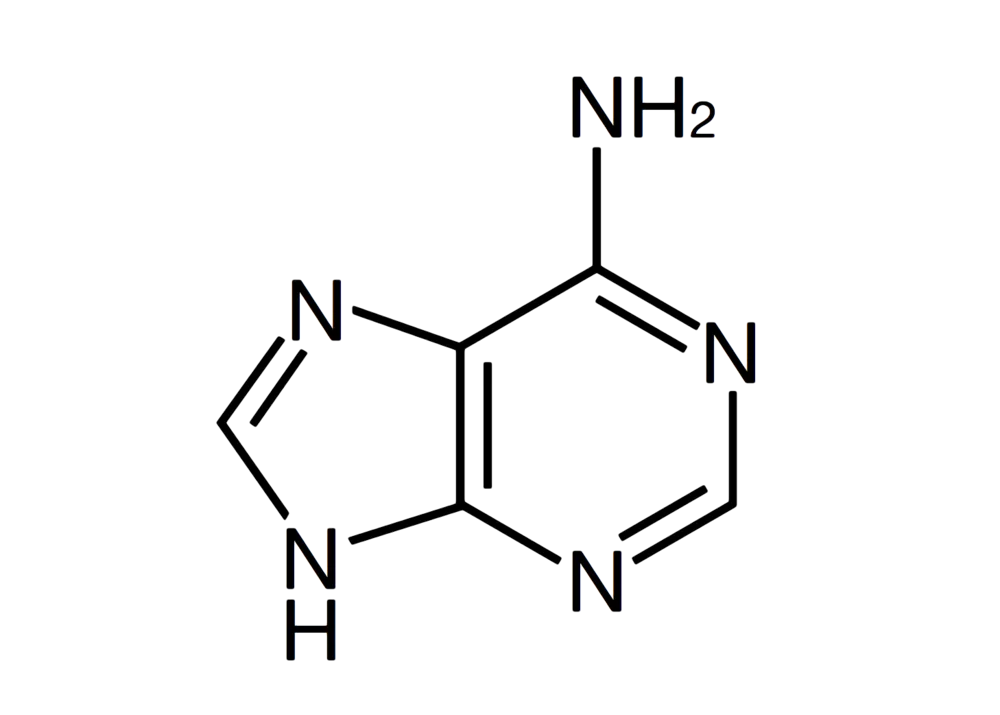
Type: Purine
Occurence: DNA/RNA
Adenine (A) is one of the four main nucleobases found in DNA and RNA, along with guanine, cytosine, and thymine (uracil in RNA). It is a purine derivative, with two heterocyclic aromatic rings and one substituent attached (an amine group at position 6). The nucleoside of adenine is adenosine. In Watson-Crick base pairing, it forms two hydrogen bonds with thymine (uracil in RNA).
Its derivatives have a variety of metabolic roles including cellular respiration, in the form of adenosine triphosphate (ATP) and the cofactors nicotinamide adenine dinucleotide (NAD) and flavin adenine dinucleotide (FAD). ATP is used in cellular metabolism as one of the basic methods of transferring chemical energy between chemical reactions. Its derivate, cyclic adenosine monophosphate (cAMP), is a second messenger that is important in many biological processes.
In 1885, Albrecht Kossel presented his discovery of adenine, which he isolated from bovine pancreas (an endocrine gland). It was named in reference to the greek prefix for gland ("aden").
Properties
Chemical formula: C₅H₅N₅
Molar mass: 135.13 g/mol
Density: 1.60 g/cm³