
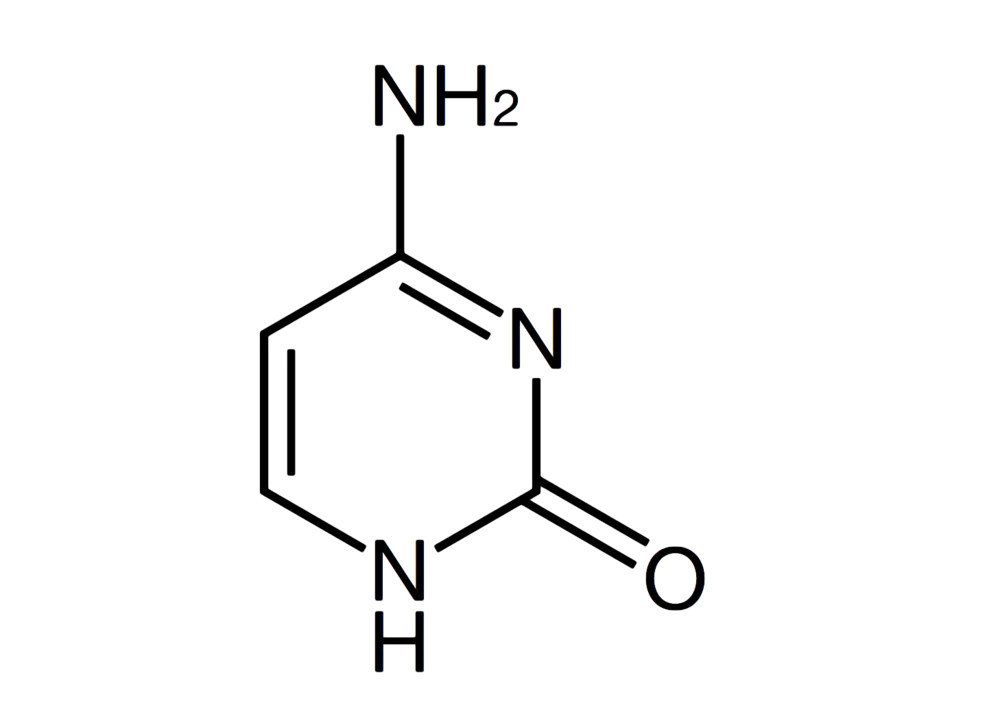
Type: Pyrimidine
Occurence: DNA/RNA
Cytosine (C) is one of the four main bases found in DNA and RNA, along with adenine, guanine, and thymine (uracil in RNA). It is a pyrimidine derivative, with a heterocyclic aromatic ring and two substituents attached (an amine group at position 4 and a keto group at position 2). The nucleoside of cytosine is cytidine. In Watson-Crick base pairing, it forms three hydrogen bonds with guanine.
As cytidine triphosphate (CTP), it can act as a co-factor to enzymes, and can transfer a phosphate to convert adenosine diphosphate (ADP) to adenosine triphosphate (ATP). Cytosine can also be methylated into 5-methylcytosine by an enzyme called DNA methyltransferase.
In 1894, cytosine was discovered isolated from calf thymus tissues by Albrecht Kossel. Its name refers to the Greek prefix for cell ("cyto").
Properties
Chemical formula: C₄H₅N₃O
Molar mass: 111.10 g/mol
Density: 1.55 g/cm³