
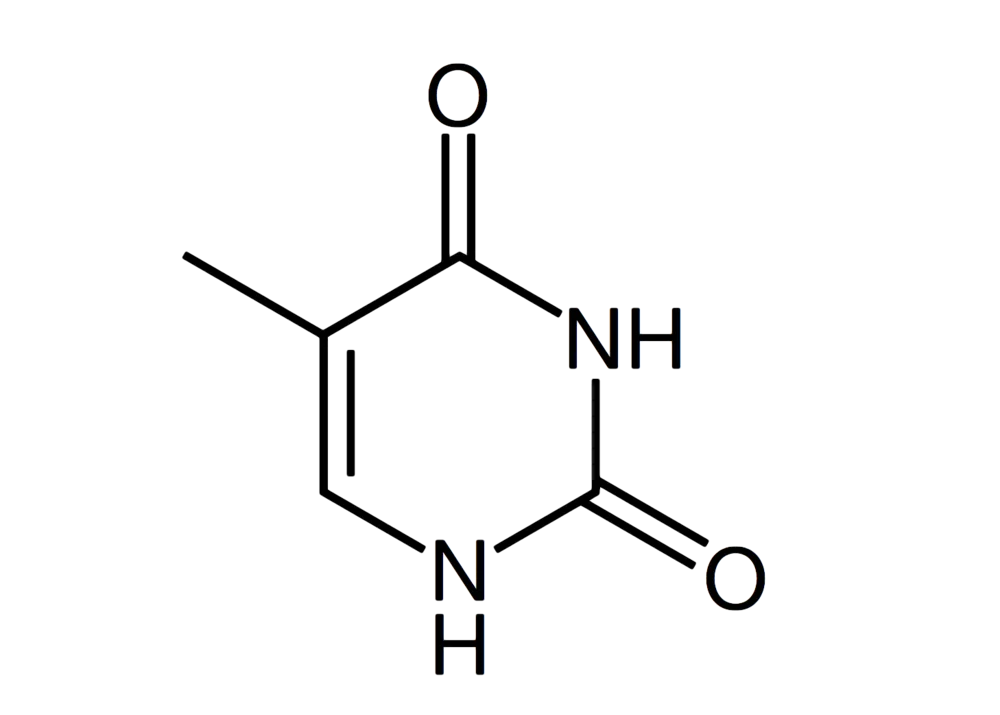
Type: Pyrimidine
Occurence: DNA
Thymine (T) is one of the four main bases found in DNA, along with adenine, guanine, and cytosine. It is a pyrimidine derivative, with a heterocyclic aromatic ring and three substituents attached (a keto group at position 2, another keto group at position 6 and a methyl group at position 5), and also known as 5-methyluracil. The nucleoside of thymine is thymidine. In Watson-Crick base pairing, it forms two hydrogen bonds with adenine.
In RNA, thymine is replaced by the nucleobase uracil. Chemically, thymine can be considered to be a derivative of uracil, and is sometimes referred to as 5-methyluracil.
In 1893, Albrecht Kossel presented the discovery of thymine, isolated in nucleic acids from calf thymus, in reference to which it was named.
Properties
Chemical formula: C₅H₆N₂O₂
Molar mass: 126.12 g/mol
Density: 1.22 g/cm³