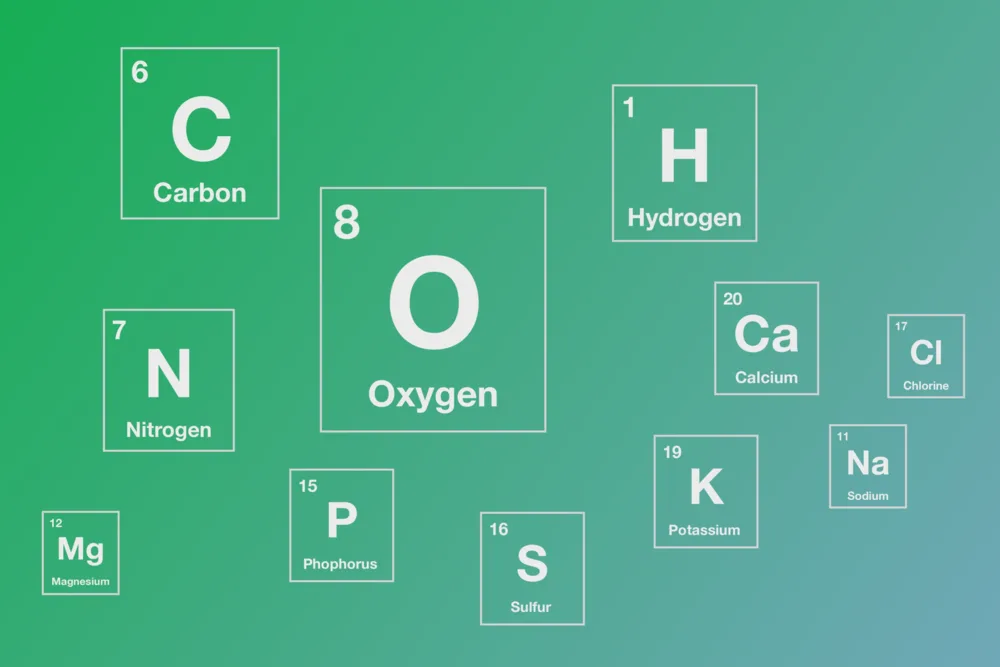
Chemistry is at the very foundation of the life sciences. Organisms can be viewed as chemical factories that perform a myriad of reactions every second just to stay alive. So in order to study the building blocks of life, we first need to understand some basic chemistry.
This section will give you a brief introduction into biologically relevant elements, atom structure, isotopes and electron shells.
Important elements
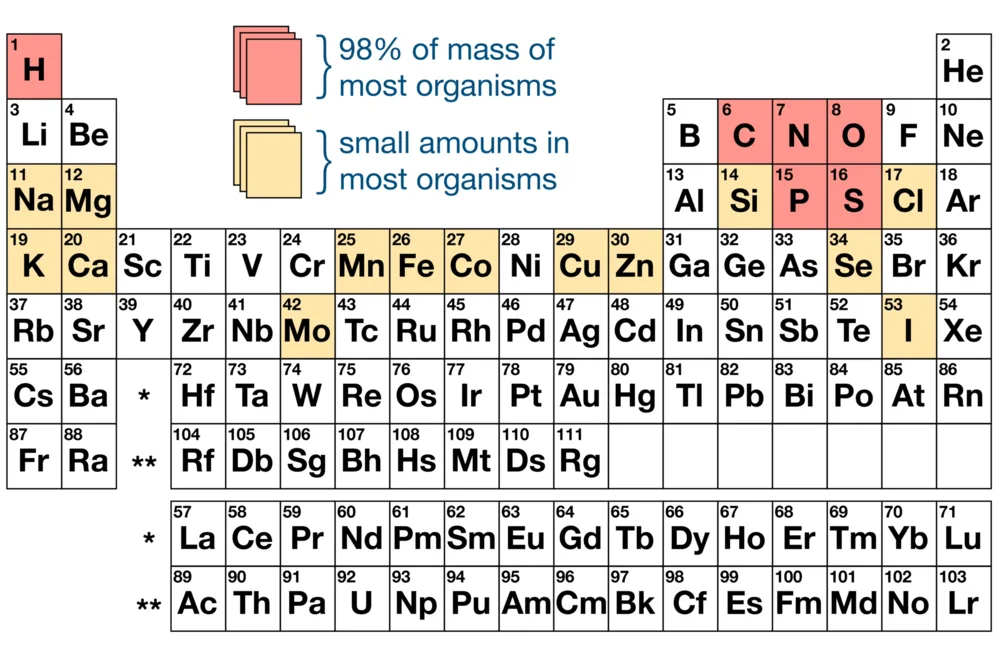
There are more than a hundred chemical elements in the periodic table, but only a relatively small number is highly relevant in biology.
About 98% of the mass of most organisms is made up of these six elements that are depicted in red: hydrogen (H), carbon (C), nitrogen (N), oxygen (O), phosphorus (P) and sulfur (S). Another subset of elements that are shown in yellow are found in smaller amounts, but are still very important. These include potassium (K), calcium (Ca), sodium (Na), chlorine (Cl) and magnesium (Mg), among others.
General structure of atoms
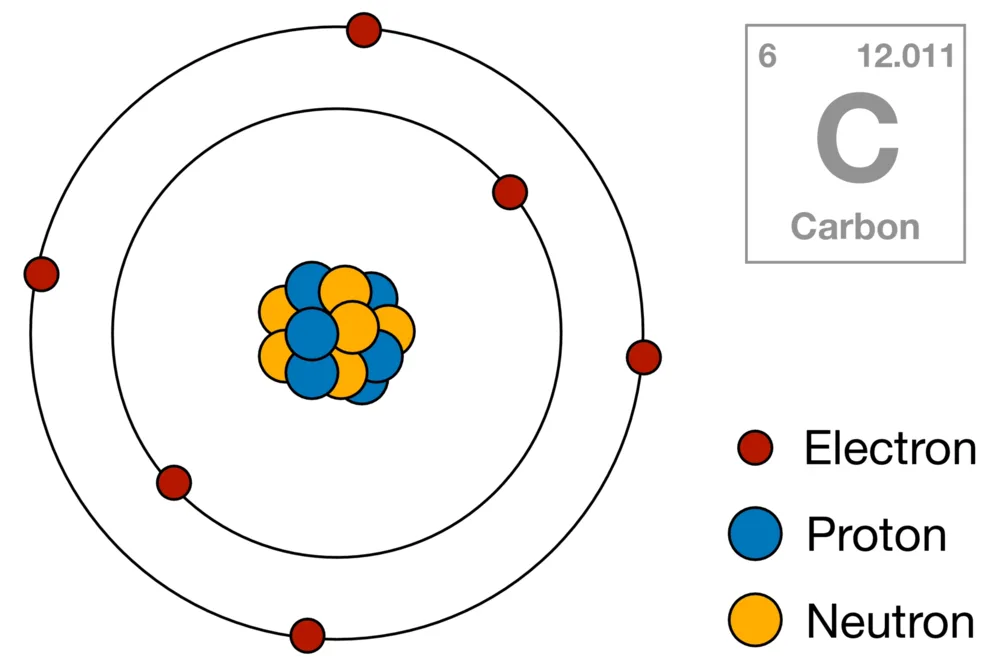
Atoms are made up of three types of particles: negatively charged electrons, positively charged protons and uncharged neutrons. The atom core (nucleus) consists of protons and neutrons, while electrons orbit around the core. A carbon atom (C), for example, has 6 protons, 6 neutrons and 6 electrons, resulting in an overall neutral charge. The atomic number (6) relates to the number of protons, which ultimately determines the element. The atomic mass of 12.011 is mostly due to the 12 core particles, whereas electrons do not contribute much to the total mass.
This typical depiction of an atom is a simplification and not at all proportional. The orbits can be rather thought of as different energy levels. Also, electrons are tiny compared to protons and neutrons, but the electron shell of an atom, the area in which electrons are located, is gigantic. If a nucleus had the size of a pinhead the shell would be as large as a cathedral. Still, this simplified model is very useful and complex enough for us to move forward.
Isotopes
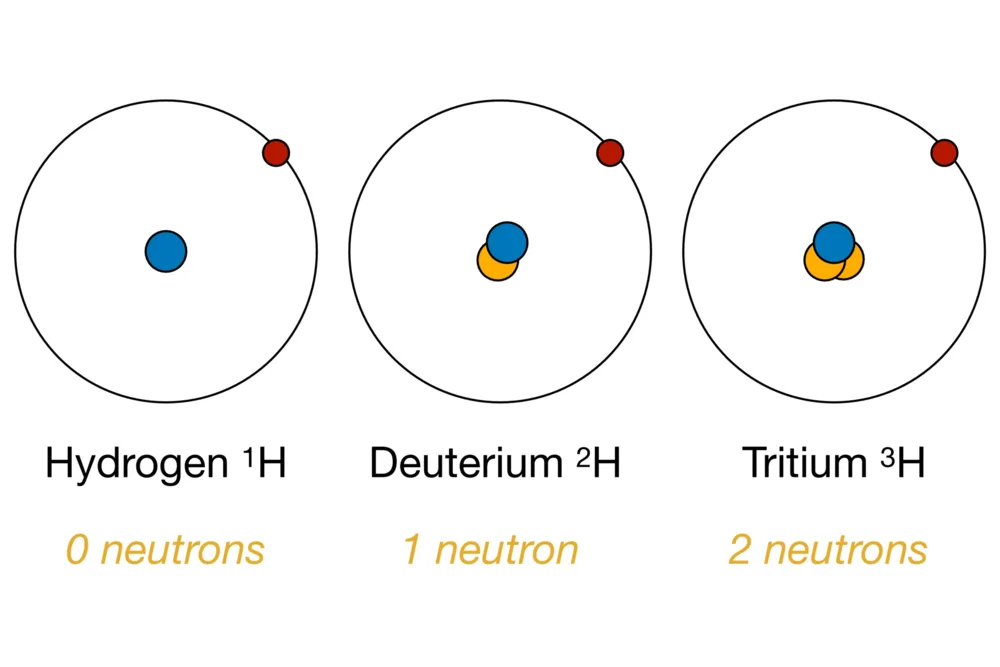
As we learned before, the number of protons determines the nature of the element. However, sometimes an element can have versions with different numbers of neutrons. These versions are called isotopes.
Hydrogen (H or ¹H) has the most simple atom structure, consisting only of one proton and one electron. Deuterium (²H) and tritium (³H) are isotopes of hydrogen with additional neutrons in the nucleus. Isotopes are often unstable, causing their cores to dacay and to emit radiation in the process.
Electron shells
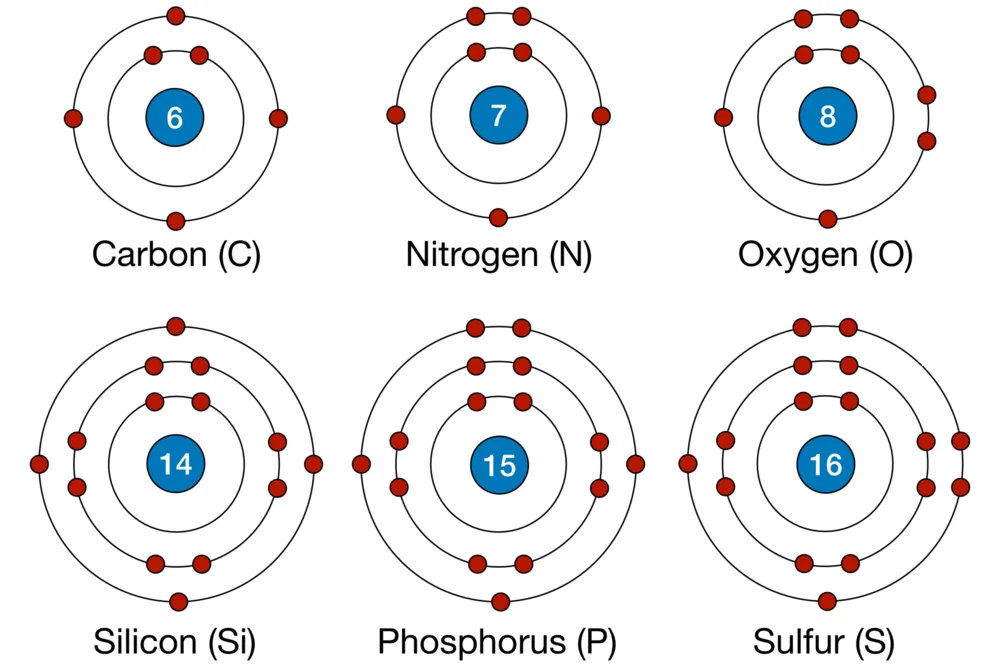
The number of electrons that are specific to each element govern the way different elements behave in chemical reactions, which involve changes in electron interaction.
Electrons are located at different shells around a nucleus. The innermost shell can hold up to two electrons, while the next one can hold eight, and the third shell can hold up to 18. The outermost shell of any atom is called valence shell, which has the most relevance for chemical interactions.
Within shells, electrons are paired in so-called orbitals. There is a proclivity to fill up all orbitals of a shell with electron pairs, which makes elements reactive, in order to reach a state of high stability. Oxygen, for example, needs two additional electrons to fill up all orbitals of its valence shell. Sulfur, although it has a third shell, similarly needs two electrons, while carbon needs four, just like silicon.
In the next section we will look at how chemical bonds are formed.