Chemical bonds bring atoms together into close and more or less stable interactions. The formation and breakup of bonds in chemical reactions is what builds and transforms substances. This is constantly happening in every living cell at all times and enables the generation of large molecules and complex organic structures.
In this section we will discuss the different kinds of chemical bonds and other sorts of interactions.
Covalent bonds
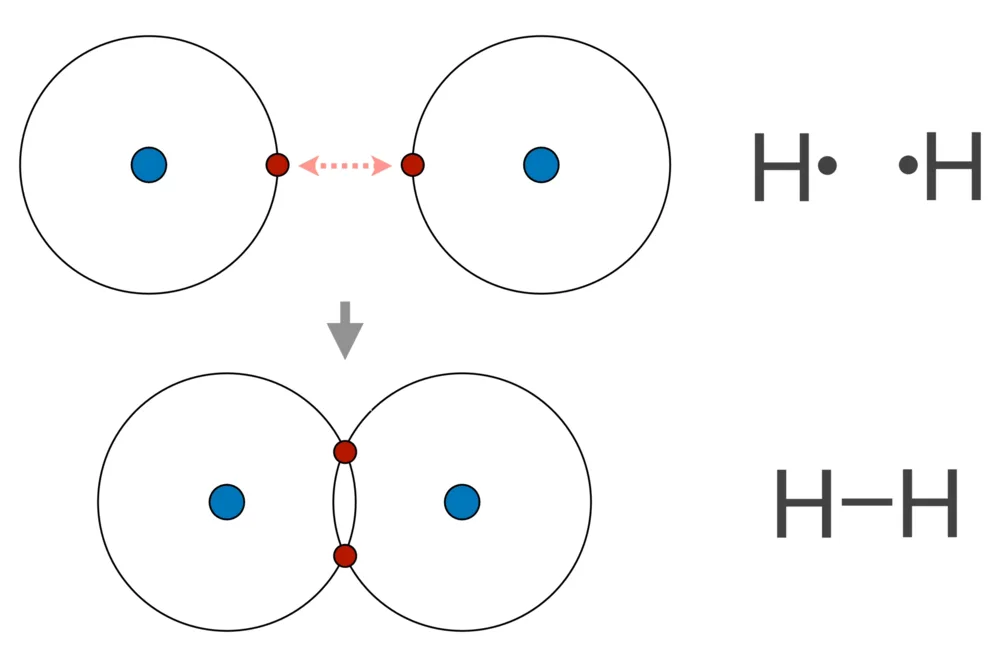
The strongest and most stable interaction between two atoms is a covalent bond. In the strive to fill up their valence shells to reach a state of high stability, two atoms can share electron pairs, forming a strong so-called covalent bond.
In the depicted example two hydrogen atoms form a bond by each sharing their only electron. Since hydrogen has only one shell, which (being the innermost) can hold up to two electrons, the two atoms filled up their valence shell in this way. Pure hydrogen normally only exists as "H₂".
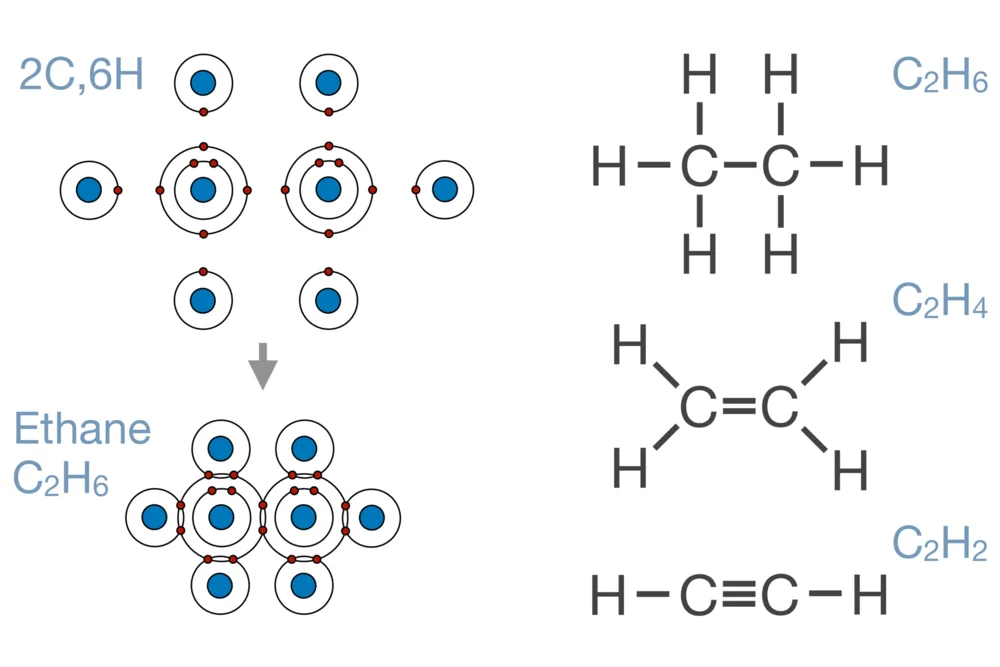
In biology, bonds between hydrogen and carbon are ubiquitous. In general, only valence electrons take part in bond formation, of which carbon has four in its outer shell. Being the second to the innermost shell, it can hold up to eight electrons, so it needs another four to reach its most stable configuration. Besides single bonds, atoms can also form multiple (e.g. double and triple) bonds. The right part of the image shows the most common way to depict chemical structures with bonds shown as lines between element symbols.
Skeletal structures
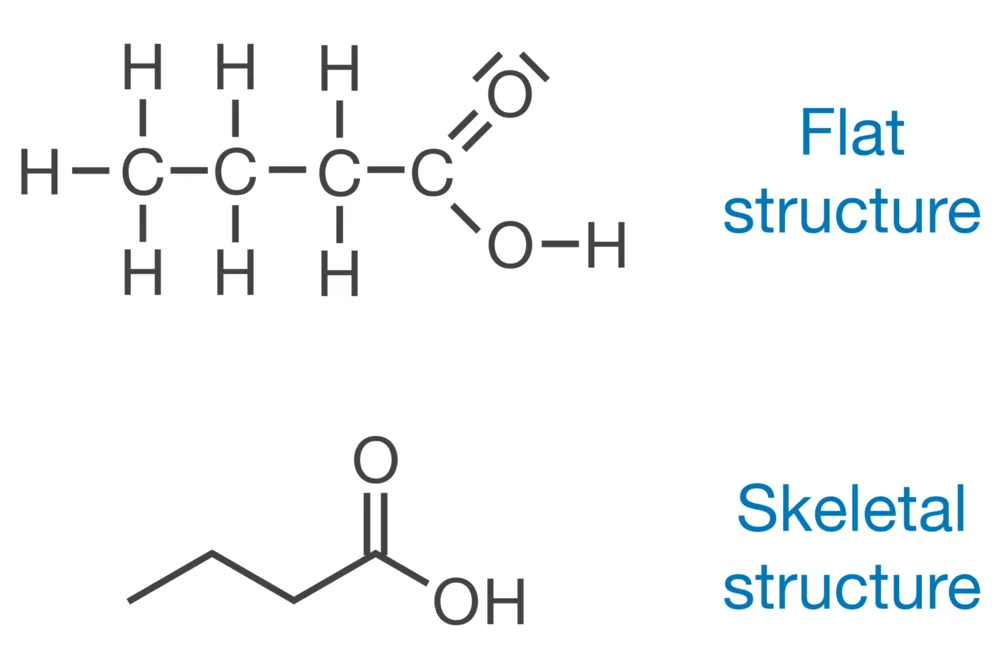
Because bonds between hydrogen and carbon are so common in organic compounds, we often use a simplified way to depict molecule structures. Only the bonds that carbon forms with other atoms, except for hydrogen, are drawn, while carbons are implied in kinks and bare endpoints. The bonds to hydrogen are omitted completely, as the number of hydrogens can be inferred from the number of bonds that a carbon atom forms to other atoms.
Typical bond numbers
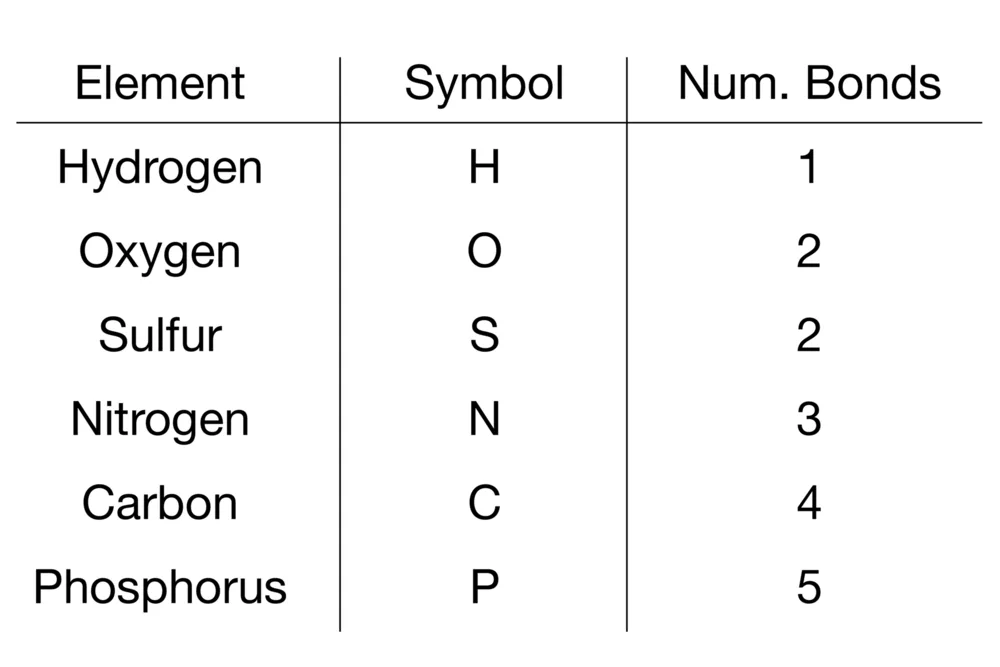
For a biologist, the most useful thing to know about covalent bonds is the typical number of bonds that each of the six biologically most important elements forms within molecules. This number is called "valency" as it directly relates to the number of electrons in the valence shell of an atom that is needed to get to a stable configuration.
Ion bonds
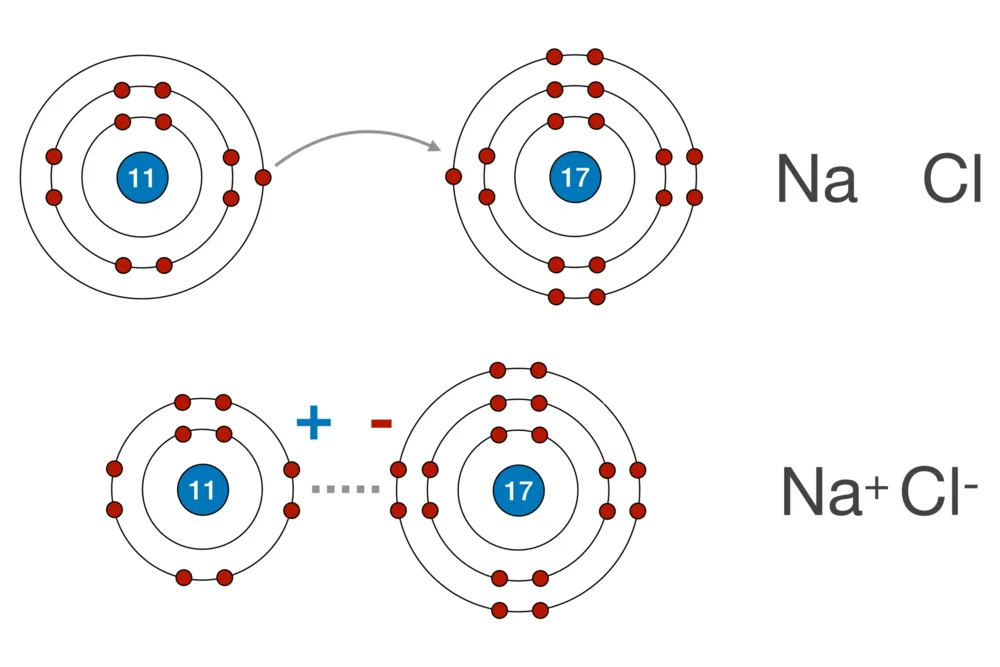
In the electron interaction between atoms of some elements, such as sodium (Na) and chlorine (Cl), the pull of one atom due to its high "electronegativity", Cl in this case, is so strong that it will not share the single valence electron of its partner, but instead will seize it outright. This results in the transformation of the atoms into charged ions that are held together by electric attraction. This interaction, called ion bond, is relatively weak with about 1/10 of the strength of a covalent bond.
Hydrogen bonds
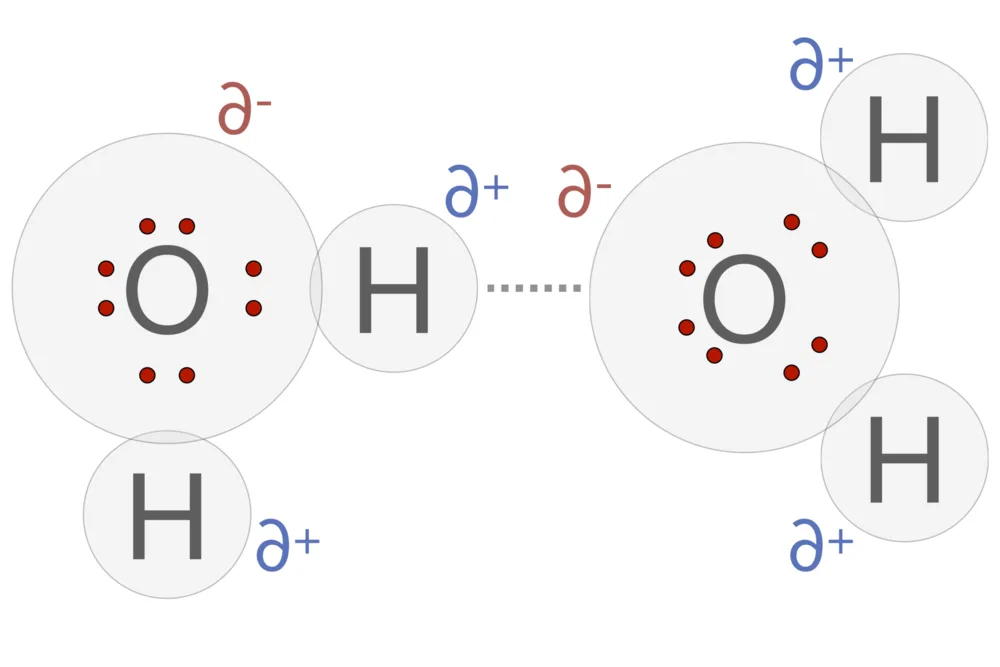
In some cases, the electron pull of two different atoms ("electronegativity") is highly unequal, but not enough for a complete electron transfer. This leads to polarity within the molecule due to a partial charge (∂⁺/∂⁻), e.g. in water molecules. Parts of different (hydrogen-containing) molecules with opposed partial charges can form so-called hydrogen bonds. Hydrogen bonds are relatively weak, similar to ion bonds.
In the next section we will learn how interactions change in chemical reactions.