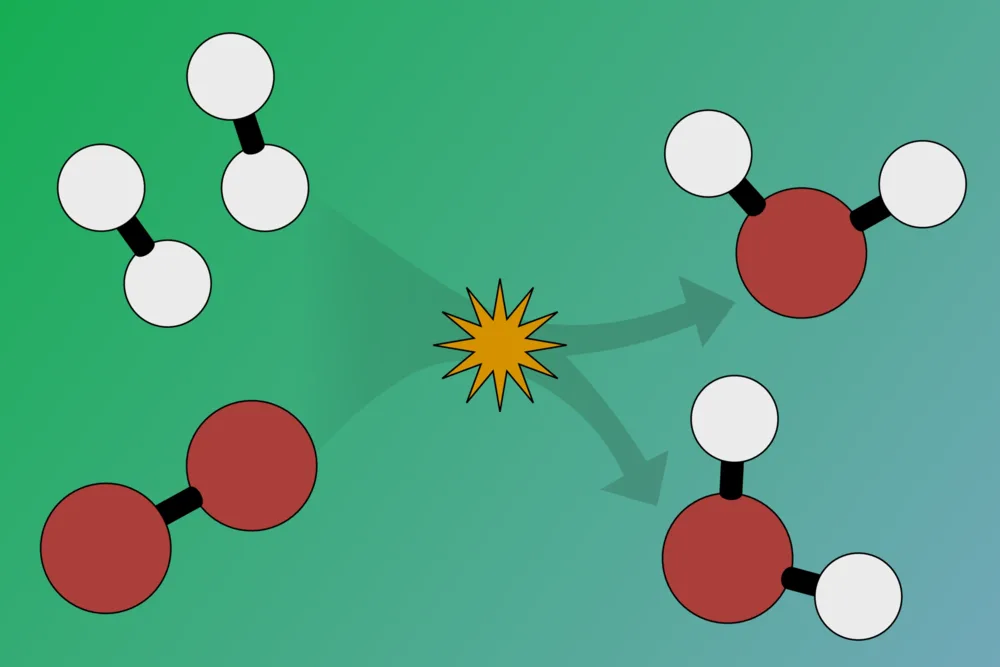
The creation of new chemical bonds and the change of interaction partners of atoms through bond breaking and formation occurs through chemical reactions. These changes to the atomic composition of substances are happening constantly in living beings to store and extract energy, to build organic structures and generally to enable all processes that are needed to sustain life.
Here, we will learn a few basic facts about chemical reactions.
Reaction types
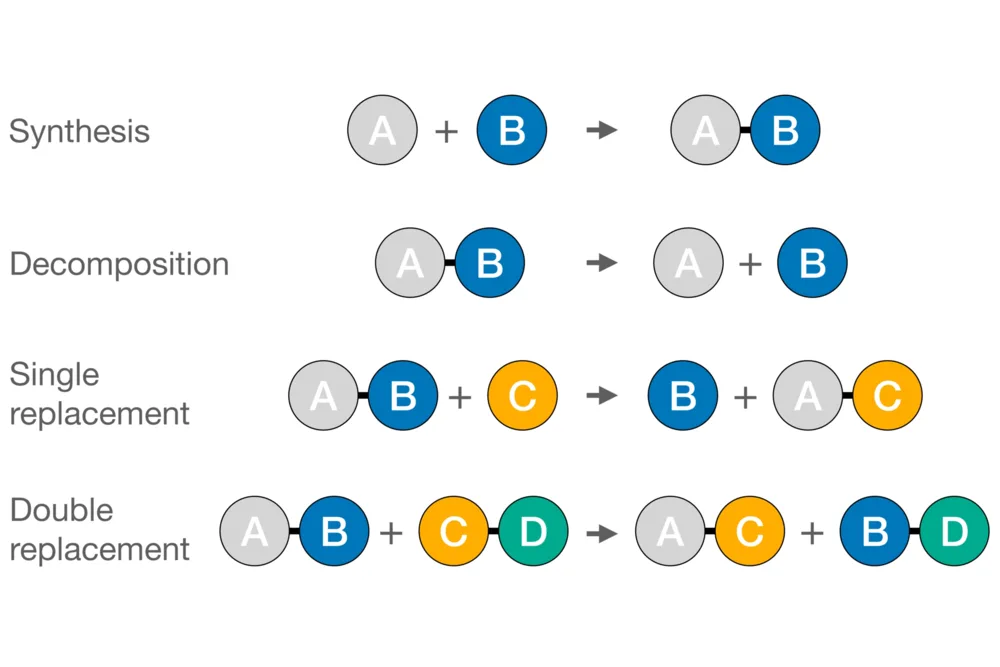
Four broad types of chemical reactions can be distinguished. In a synthesis reaction, substances combine to form more complex molecules, whereas in decompositions, molecules break up into seperate parts. In single replacements, an uncombined element replaces another in a given compound. Finally, in a double replacement, two elements of two respective compounds switch places. The image shows a very simplified summary with symbolic representations of compound parts.
Chemical equations
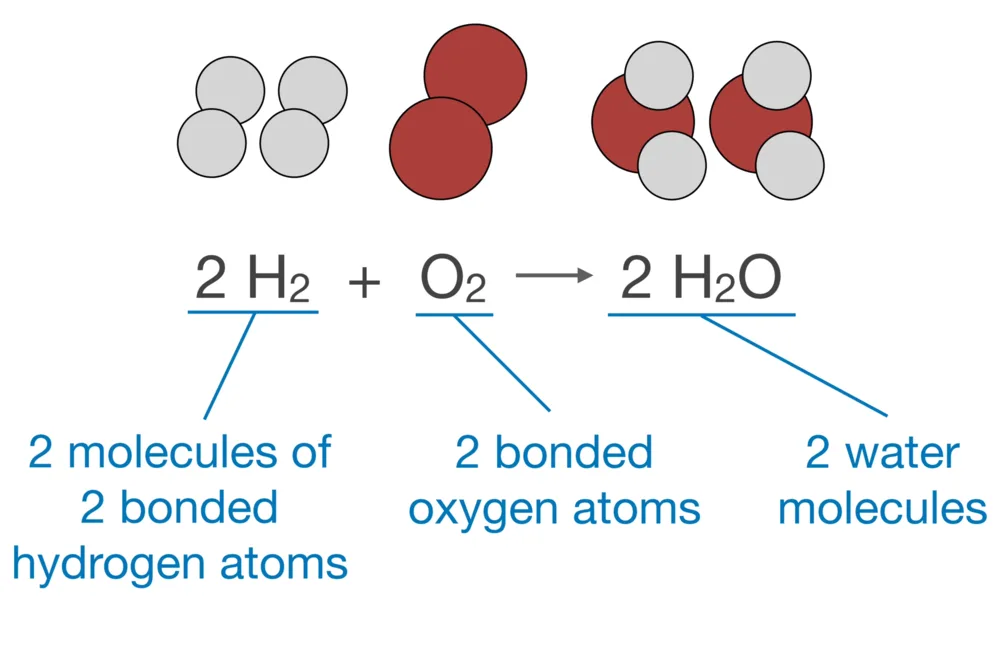
Chemical reactions are represented by equations like the one depicted here. The reactants are shown on the left side of the arrow and the products are given on the right side. The arrow shows the direction of the reaction. Each compound is represented by its formula and the number of molecules that are required for the reaction.
Importantly, the total number of each atom have to be equal on either side of the equation. In this example we have four hydrogen atoms and two oxygen atoms on each side of the arrow.
Chemical equilibrium
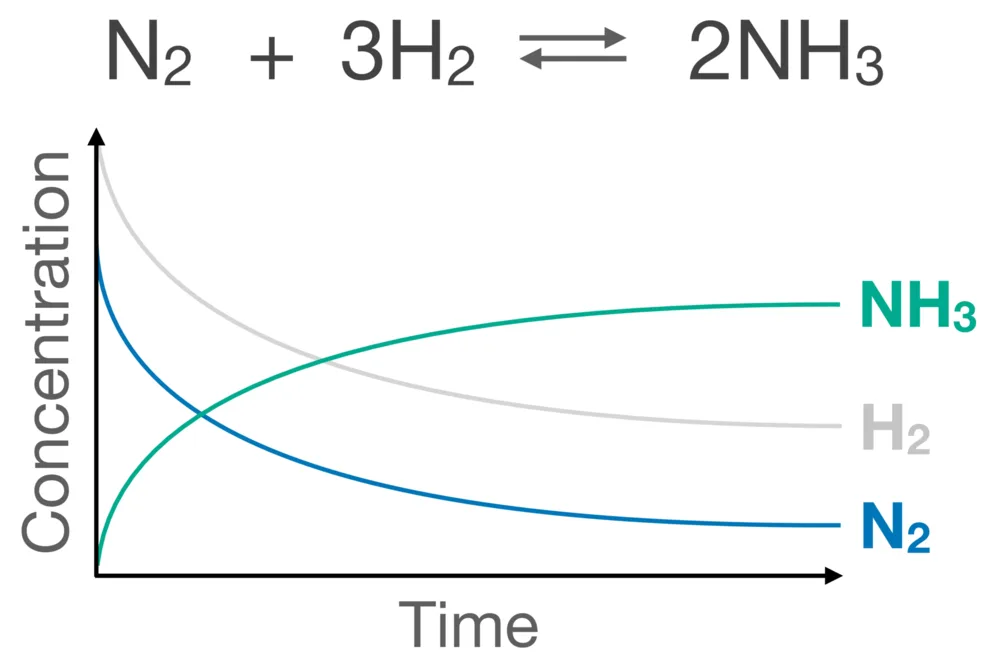
Most chemical reactions are reversible, so they can run in both directions. To indicate this, two arrows are shown, which indicate both directions. Reversible reactions reach a point of equilibrium, in which the rates of both directions are equal, but it can be strongly shifted towards one side. In this example, the total amount of N₂, H₂ and NH₃ does not change after reaching the equilibrium state, while NH₃ is the most abundand molecule.
Catalysts
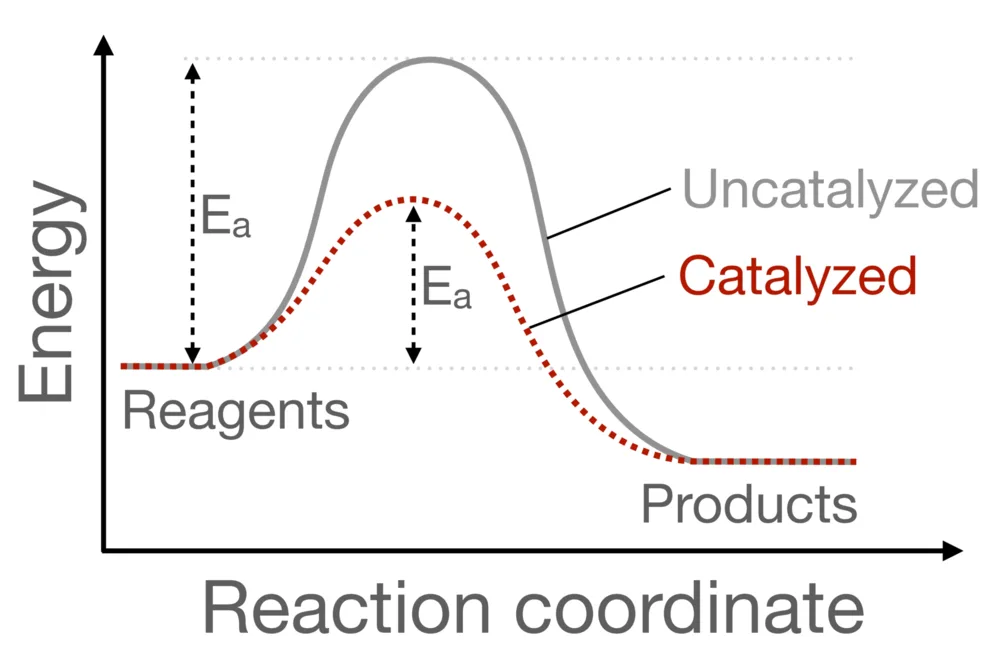
Some reactions are influenced by catalysts. These substances affect the rate of chemical reactions without being consumed in the process, but they do not influence the specific equilibrium of a reaction. Catalysts facilitate reactions through decrease of the specific activation energy (Eₐ) and thereby flattening the energy profile of a chemical reaction as depicted. Specific proteins called enzymes, are important biological catalysts that act in distinct biochemical pathways.
It is important to understand that enzymes, and catalysts in general, do not change the equilibrium of a chemical reaction. Roughly speaking, they just "decrease friction" and help to reach that equilibrium much quicker. This means that the direction of the reaction is still determined by the ratio of molecules on each side of the equation.
The next section will discuss molecule parts with particular importance for chemical reactions.