
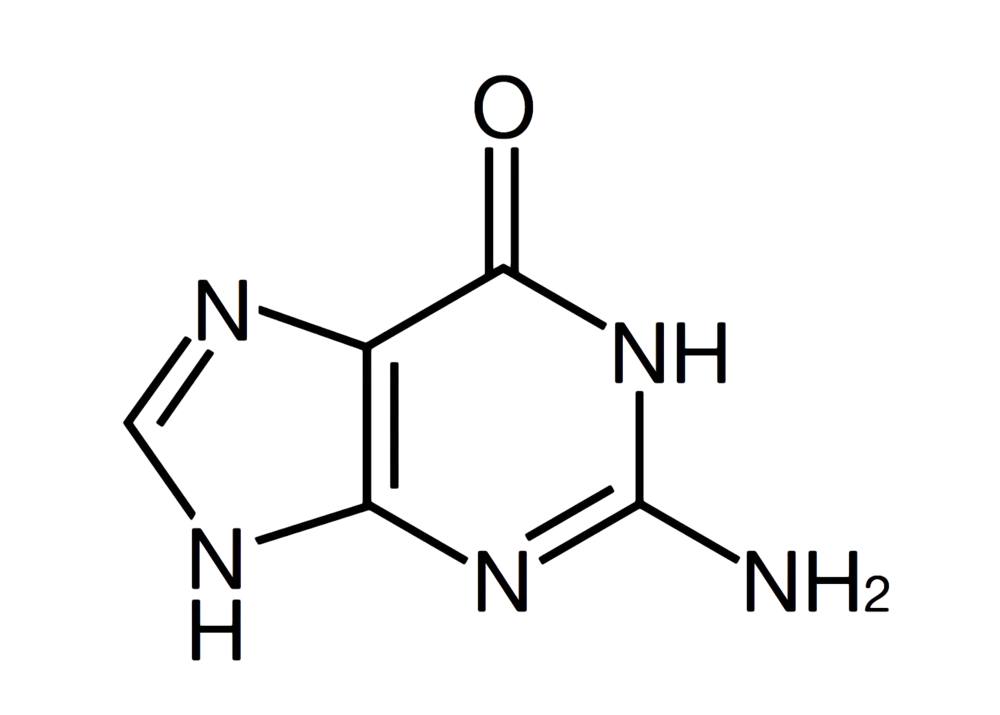
Type: Purine
Occurence: DNA/RNA
Guanine (G) is one of the four main bases found in DNA and RNA, along with adenine, cytosine, and thymine (uracil in RNA). It is a purine derivative, with two heterocyclic aromatic rings and two substituents attached (an amine group at position 2 and a keto group at position 6). The nucleoside of guanine is guanosine. In Watson-Crick base pairing, it forms three hydrogen bonds with cytosine.
Its derivate guanosine triphosphate (GTP) has the role of a source of energy and as activator of substrates in metabolic reactions, like that of ATP, but more specific. It is used as a source of energy for protein synthesis and gluconeogenesis. GTP is also essential to signal transduction, in particular with G-proteins, in second-messenger mechanisms where it is converted to guanosine diphosphate (GDP) through the action of GTPases.
In 1844, Julius Unger reported the isolation of guanine as a mineral formed from the excreta of sea birds, which is known as "guano" (Spanish from Quechua: "wanu"). Later, in 1883, Albrecht Kossel showed that guanine was a cleavage product of nuclein.
Properties
Chemical formula: C₅H₅N₅O
Molar mass: 151.13 g/mol
Density: 2.20 g/cm³