
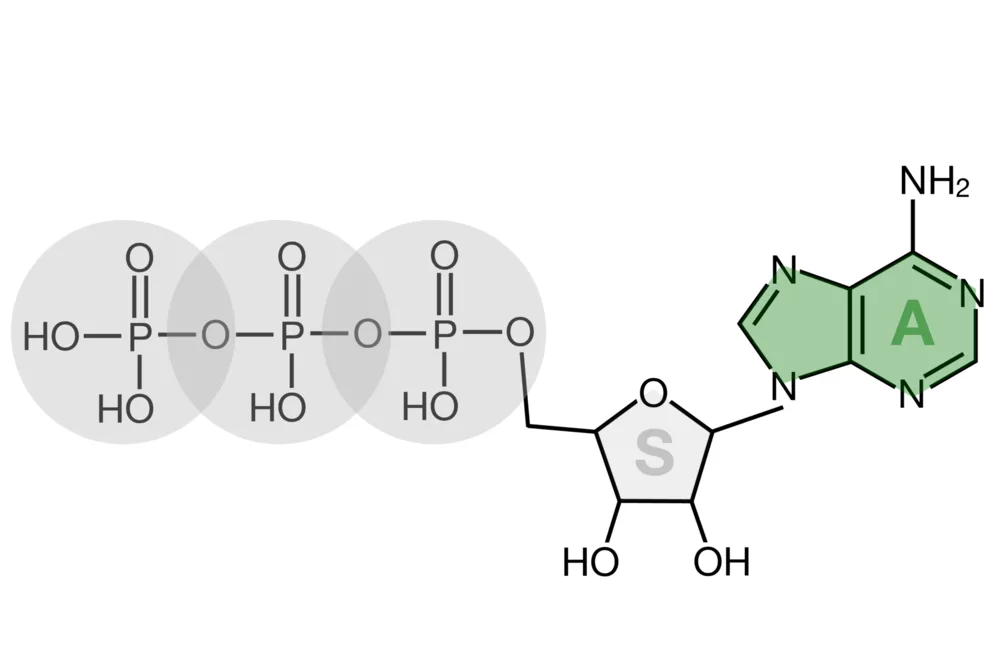
Sugar plus nucleobase, without a phosphate
Adenosine, guanosine, cytidine, uridine, thymidine
A nucleoside consists of a nucleobase attached to the 1' carbon of a ribose or deoxyribose sugar. It has no phosphate group, which distinguishes it from a nucleotide. The nucleosides of RNA are adenosine, guanosine, cytidine, and uridine, while DNA contains their deoxy forms and thymidine. Adding phosphate groups at the 5' carbon turns a nucleoside into a nucleoside monophosphate, diphosphate, or triphosphate. Nucleoside triphosphates, such as ATP and GTP, are the precursors from which DNA and RNA are built, and they carry energy in the cell.