Some substances, called acids, release hydrogen ions - essentially protons - when they dissolve in water. Other substances, called bases, accept protons when they are in solution with water. Protons are highly reactive and can cause damage to organic matter. Generally, the concentration of protons in an aqueous medium has a large impact for organisms and has to be tightly regulated.
This section will discuss acids, bases and the pH scale.
Acids
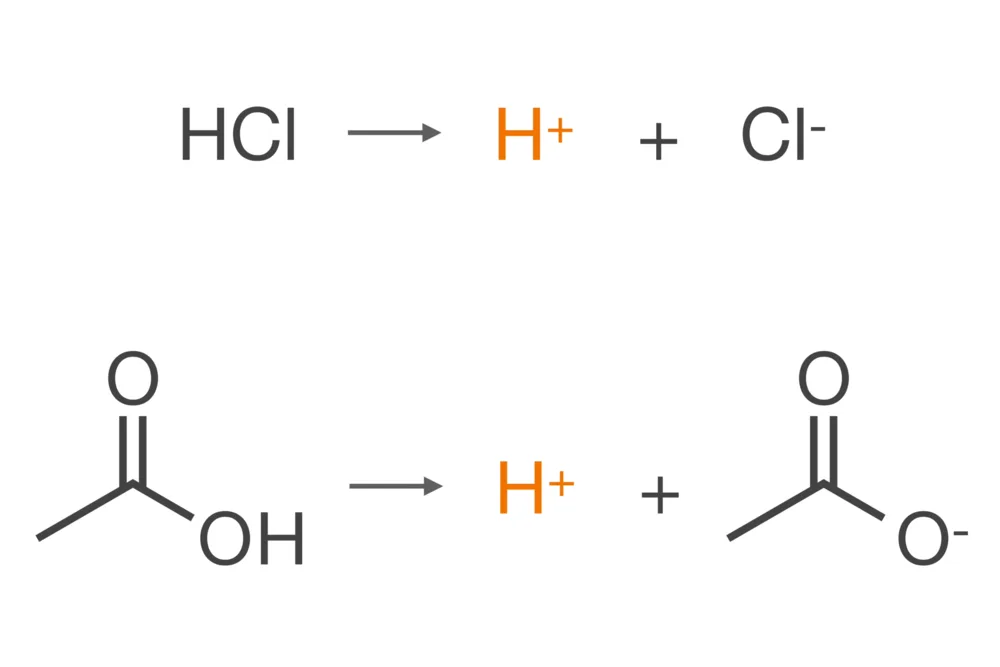
When acids dissolve in water they ionize and release H⁺ ions (protons). A strong acid, such as hydrochloric acid (HCl), dissociates completely into H⁺ and Cl⁻ ions. A weak acid, such as acetic acid (CH₃COOH), on the other hand, does not dissociate completely, since a considerable amount of the initial molecule will not be ionized. The higher the H⁺ concentration, the higher the acidity.
Bases
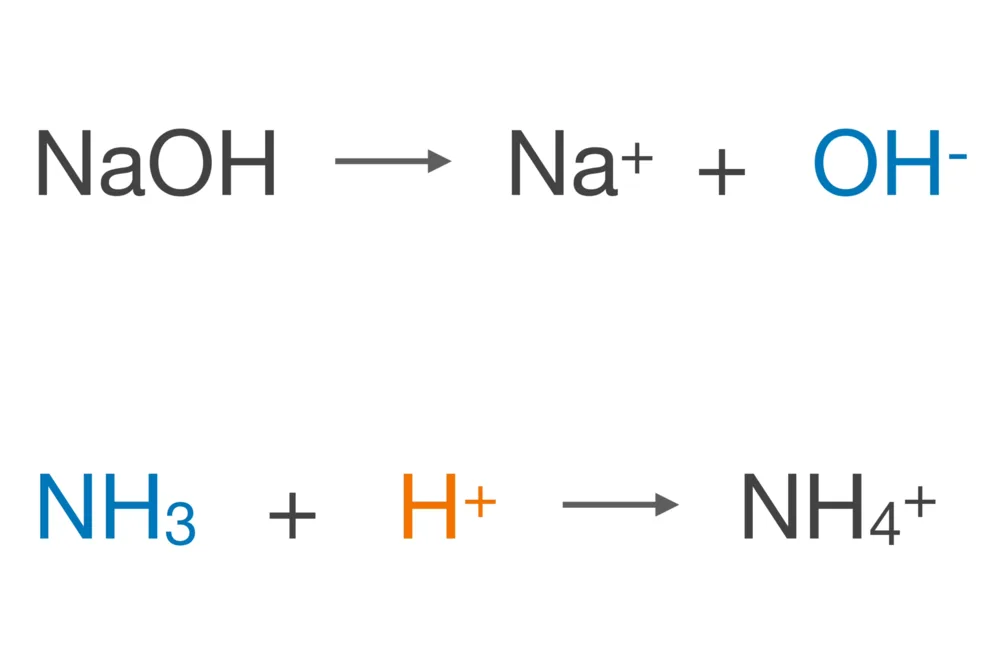
While acids are H⁺ donors, bases are essentially H⁺ acceptors. In solution, a strong base like sodium hydroxide (NaOH) dissociates completely into Na⁺ and OH⁻ ions. The resulting OH⁻ (hydroxide) ions combine with protons and form water molecules. Ammonia (NH₃) is another base that takes in protons to form ammonium (NH₄⁺). It is a weak base, because only a certain percentage of ammonia molecules in solution accept protons. The higher the capacity for H⁺ acceptance, the stronger the base.
The pH scale
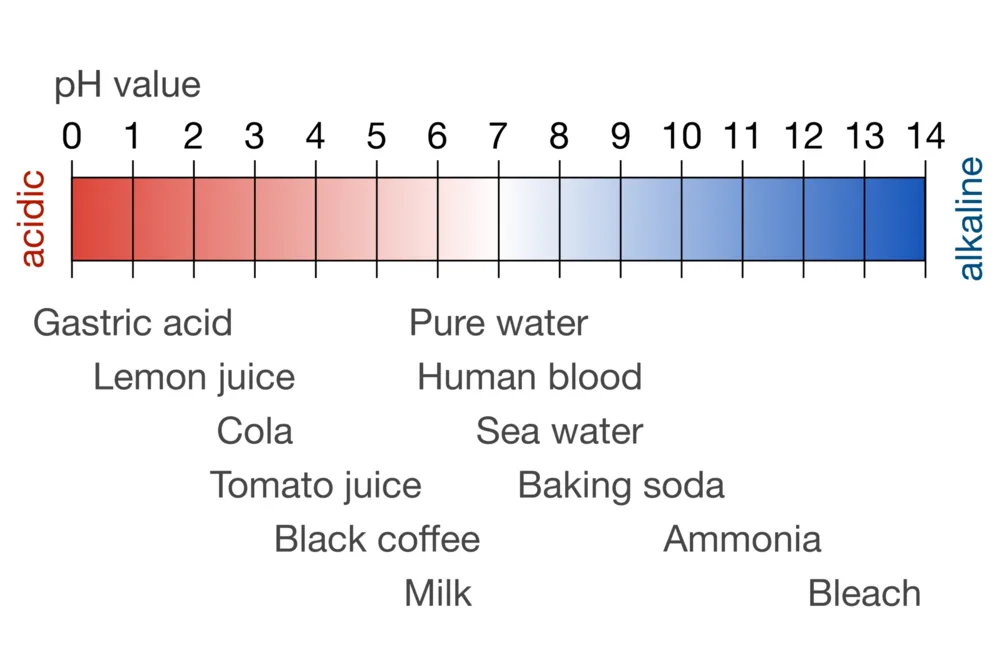
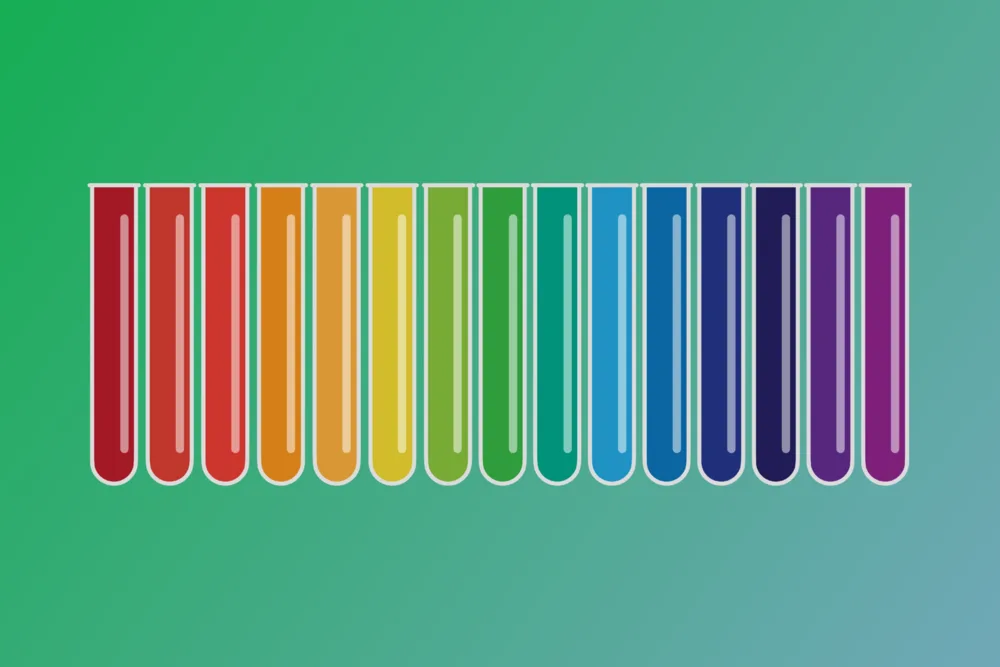
The acidity or basicity of a solution is measured using the pH scale, which ranges from 0 to 14. The highest acidity is reached at pH 0 and solutions that are less acidic have higher pH values. A neutral solution, e.g. pure water, has a pH of 7 and higher pH values indicate basicity, which reaches the maximum at pH 14. The figure shows some examples of solutions with their pH range. The pH scale is based on the H⁺ ion concentration and is logarithmic, so at say pH 4 the H⁺ concentration is 10 times higher than at pH 5.
Buffer systems
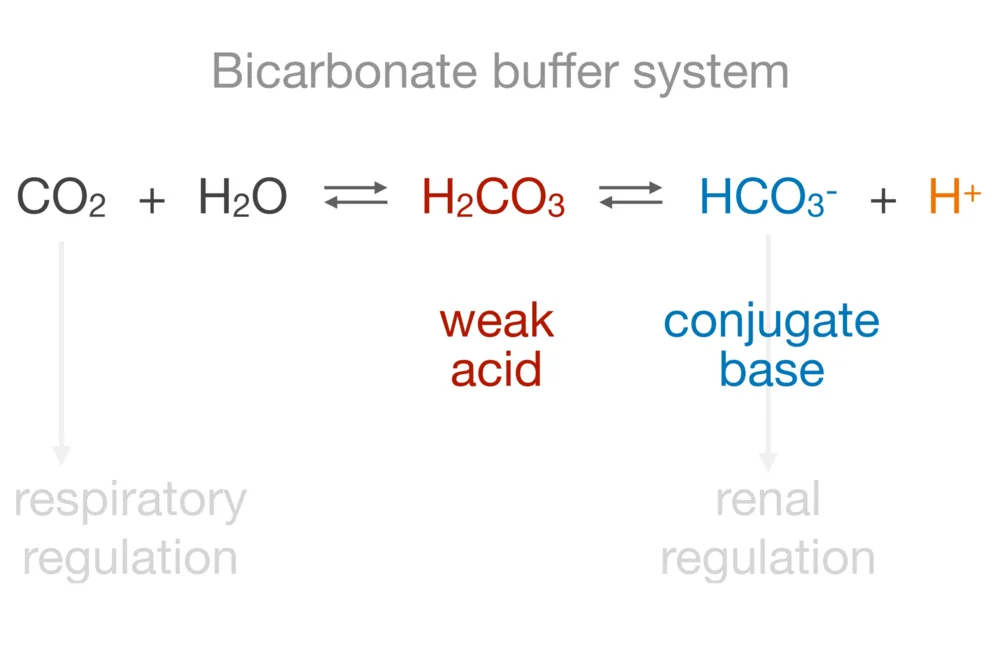
Since proton concentration changes can have a large biochemical impact, organisms use buffers to keep the pH constant. Buffer systems usually consist of a weak acid and its corresponding (conjugate) base. The pH of human blood (7.4) is regulated by the here depicted bicarbonate buffer system, consisting of carbonic acid and its conjugate base bicarbonite. Additional protons are absorbed by a shift in the reaction balance towards carbonic acid and to the formation of carbon dioxide and water, preventing a change in pH.