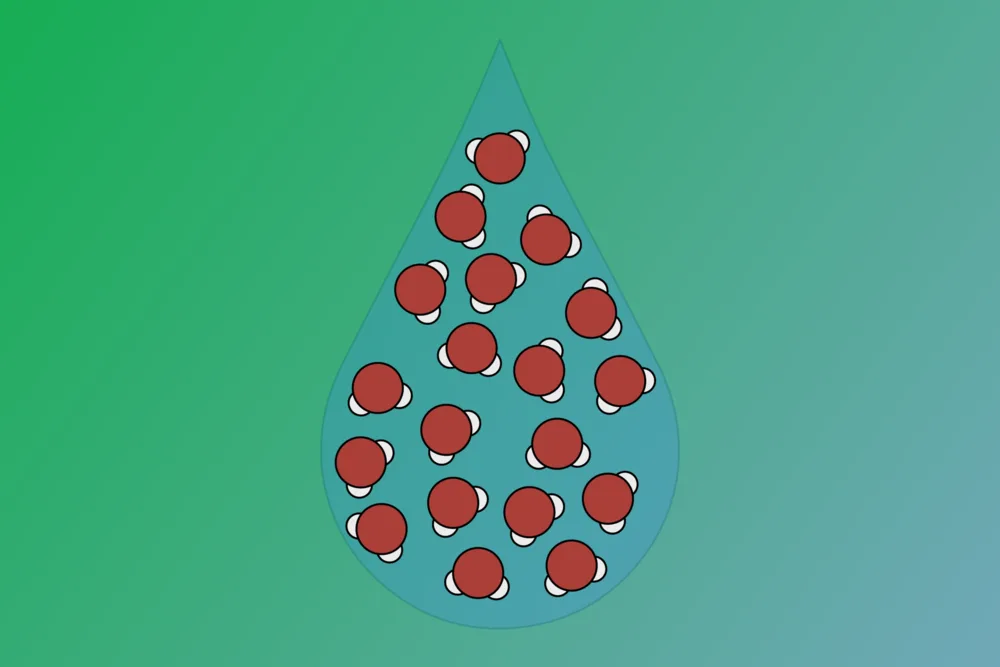
Water is absolutely fundamental for all forms of life on earth. It is the medium in which living organisms most likely first evolved and it is ubiquitously present in all cells. It is fitting that the Greek primordial god of water, Hydros, as one of the first beings to have existed, has no forebears and brought the earth, Gaia, into existence.
Water is so important in biology that this whole section is about this structurally simple molecule.
The water molecule
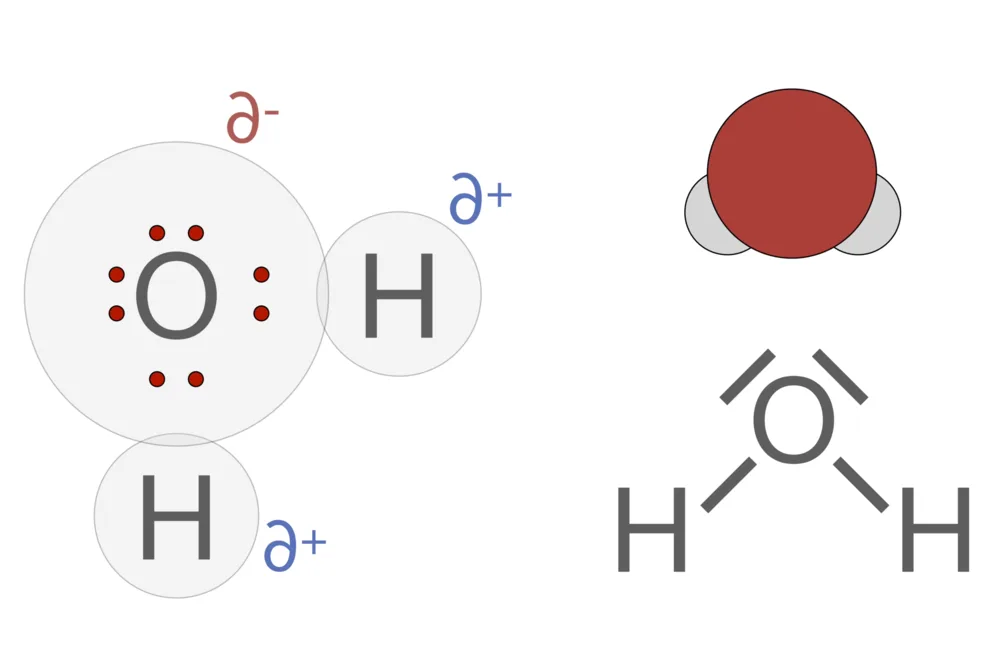
We have already briefly discussed the molecular structure of water (H₂O) in a previous section on atomic interactions. A single molecule consists of two hydrogen atoms that are covalently bound to an oxygen atom. The high electronegativity of oxygen causes a polarity within the molecule, resulting in a negative partial charge at the oxygen and positive partial charges at the hydrogens. The figure shows different ways of representation for the water molecule structure.
States of water
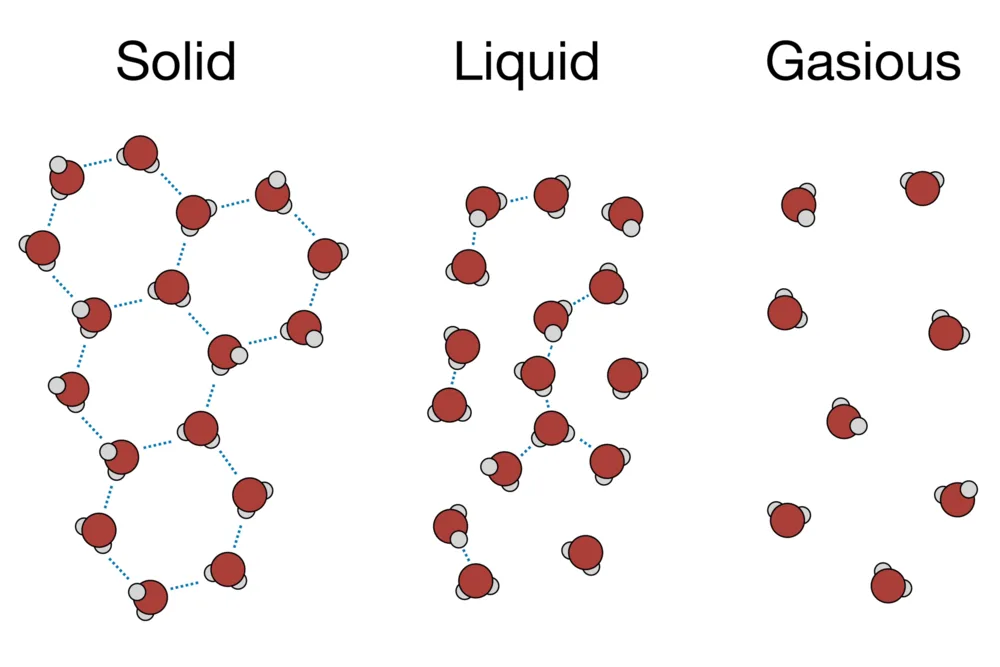
Water, like other substances, has different states of matter, i.e. solid, liquid and gasious. These states are mostly determined by the amount of hydrogen bonds that water molecules form among each other. In the liquid state, hydrogen bonds constantly break and form anew. Lower temparatures increase the share of molecules that interact through hydrogen bonds and solidify and structure their aggregation, while higher temperatures break up hydrogen bonds and cause the water molecules to disassociate.
Hydrophilia and -phobia
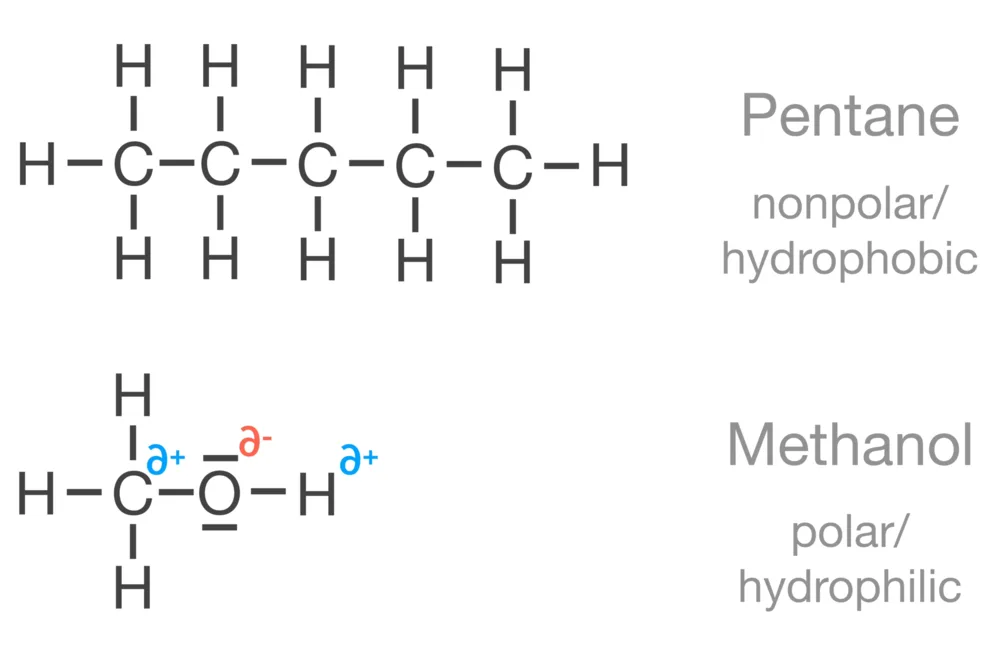
The polarity of a molecule is an important chemical trait. Polar molecules like water attract each other, just as nonpolar molecules like hydrocarbons aggregate amongst themselves. In contrast, polar and nonpolar molecules repel one another. Since water is such an important and ubiquitous medium, polar substances are called hydrophilic, while nonpolar compounds are called hydrophobic. The aggregation of hydrophobic molecules is also reinforced by hydrophobic interactions, e.g. through "Van der Waals forces".
Solubility in water
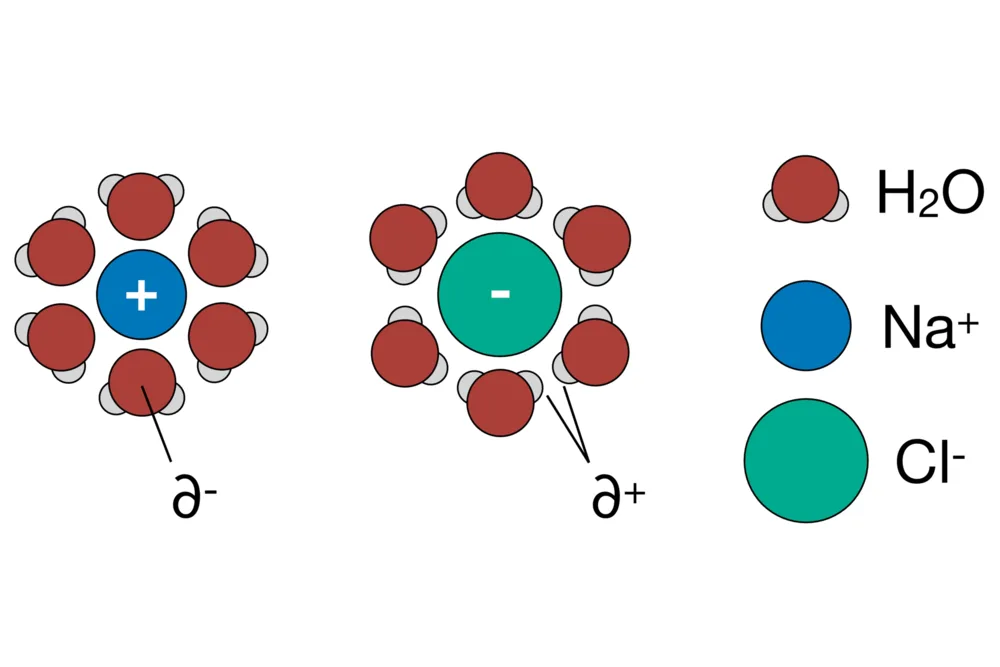
The solubility of different substances in water is determined by their polarity. Ions such as Na⁺ and Cl⁻ (NaCl, common salt), or polar (hydrophilic) molecules such as ethanol are soluble in water, while lipids for example, being hydrophobic, are not. In a solution, water molecules form hydration shells around soluble molecules or ions. Ions in particular are separated from each other in this process as depicted here.
The next section will discuss acids and bases - highly important compounds that disassociate in aqueous solution.