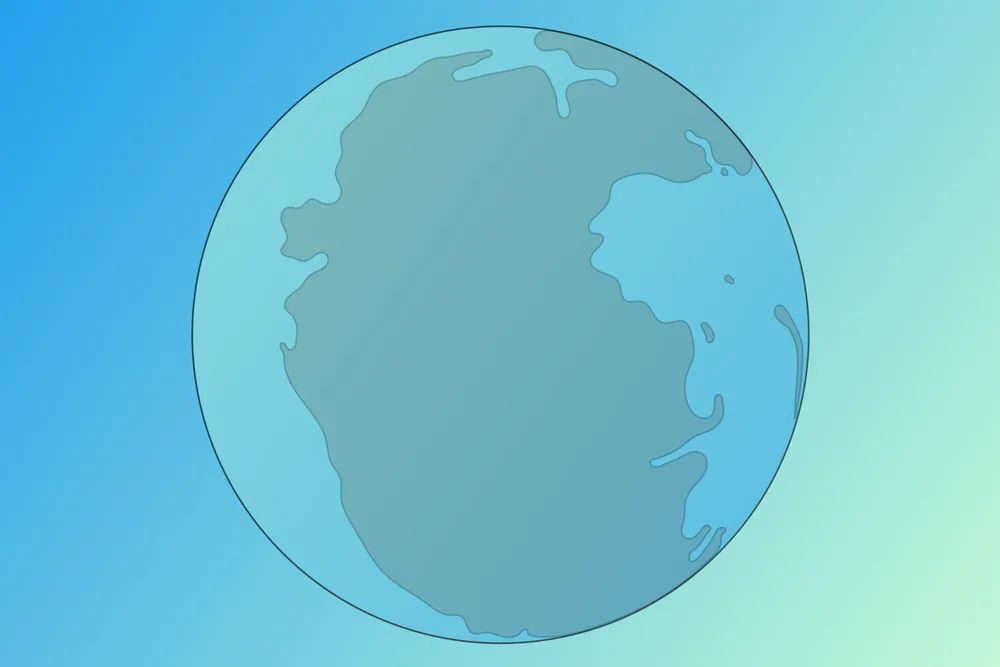
If we could go back in time the world would look less and less familiar to us. Everything changes and evolves, including our planet and its inhabiting species. As the ancient Greek philosopher Heraclitus of Ephesus (535-475 BC) said: "everything flows" (panta rhei) - and change is the only constant.
In this section, we will look at the timeline in the evolution of life on earth from its humble beginnings until today.
The Eons - Hadean
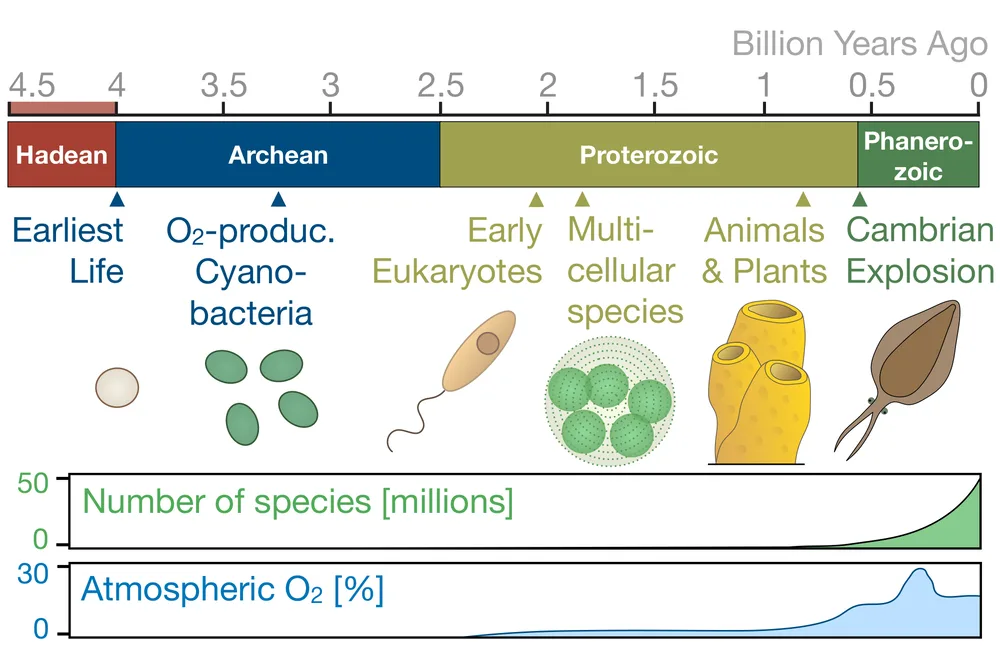
Our planet, and our solar system, formed about 4.5 billion years ago (Ga) - the universe was 9.3 billion years old at that time.
The geological time scale is broadly divided into four so-called eons. The first eon, the Hadean, is named after the Greek god of the underworld Hades, due to the hellish conditions of this period, which lasted from 4.5 to 4 Ga. The earth was fiery, hot and chaotic - altogether hostile to life.
The Eons - Archean
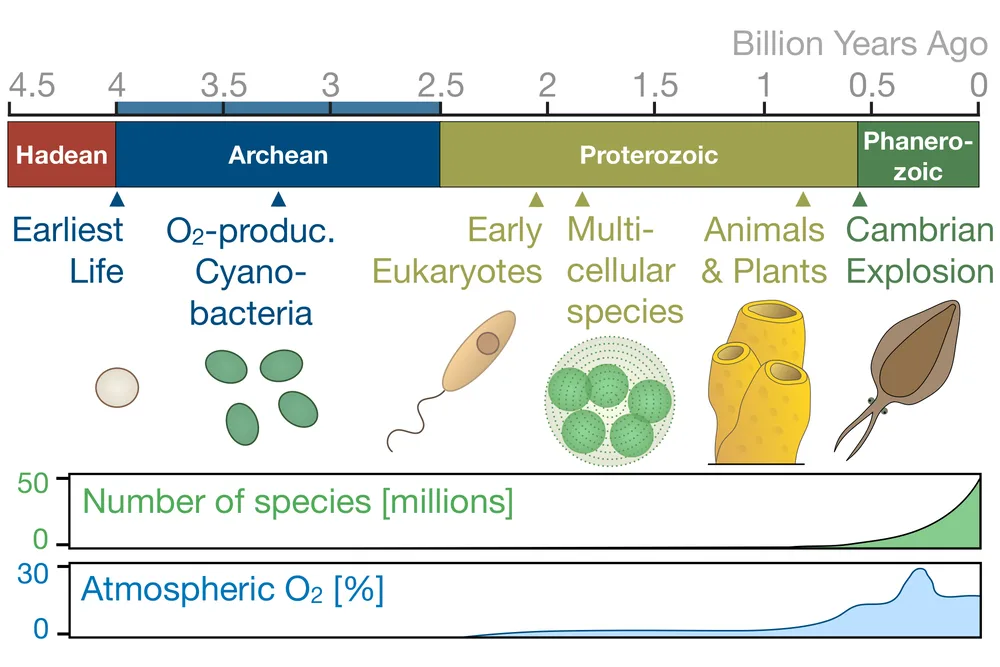
At the beginning of the next eon, the Archean, earth's crust had cooled enough for continents and oceans to form. The earliest evidence of life can be dated to this period, around 4-3.7 Ga, probably as very simple self-replicating prokaryotic single cells (i.e. bacteria and archaea) that formed in the oceans.
Is it not astonishing that life on earth began so quickly after the conditions allowed it?
The Archean lasted until about 2.5 Ga. The atmosphere was virtually free of oxygen until some organisms, so-called cyanobacteria, first developed photosynthesis, as a means to use the energy of the sun to build carbohydrates from carbon dioxide (CO₂) and water (H₂O), releasing oxygen (O₂) as a waste product. However, oxygen levels still remained very low for a long time and only slowly started to considerably increase during the next eon, the Proterozoic.
The Eons - Proterozoic
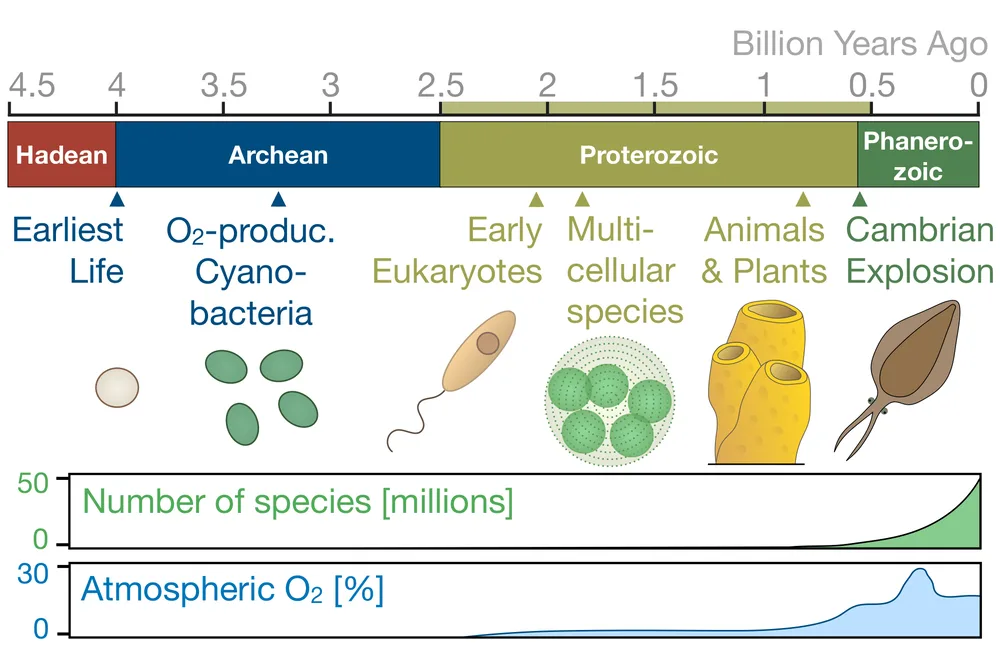
Many milestones for life on earth happened during the Proterozoic, which lasted from 2.5 to about 0.55 Ga. The first eukaryotes, large cells with nuclei, emerged about 2 Ga, likely as flagellated single cells that are similar to today's Protozoa/Protists (e.g. euglena and paramecium).
Soon after, the first multi-cellular eukaryotes developed, probably starting as colony-forming protists. Most likely, those were similar to species like the spheric green algae Volvox that still exists today.
Towards the end of the Proterozoic, the first primitive plants and animals, as well as fungi, emerged. The first animals are thought to have been similar to today's sponges, namely being sessile and lacking muscle or nerve cells or other complex structures of modern animals. Plants evolved from green algae, which besides having mitochondria like all eukaryotes, contain chloroplasts. These organelles likely evolved from incorporated cyanobacteria, while mitochondria originated from other "swallowed" prokaryotes.
The Eons - Phanerozoic
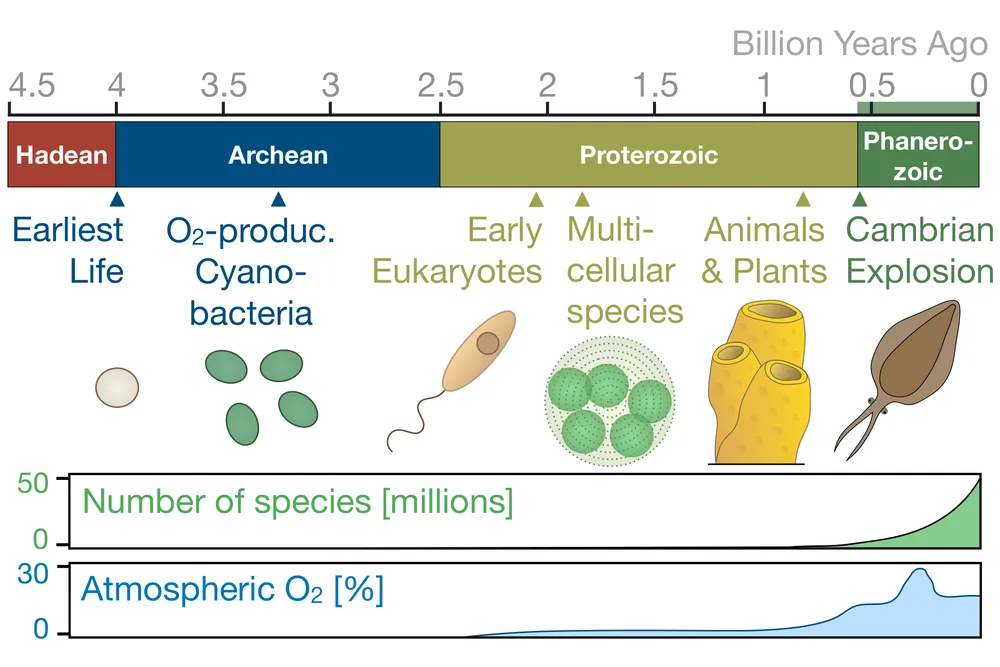
The fourth eon, the Phanerozoic, which spans from 550 million years ago (Ma) until today, is marked by an enormous increase and acceleration in biodiversity, accompanied by a marked increase in oxygen levels. Considering that it took more than two billion years to get from single-celled prokaryotes to multicellular eukaryotes and then another billion to the emergence of plants and animals, this last much shorter period witnessed a breathtaking pace in evolutionary innovation. This eon was heralded by the "Cambrian explosion."
The Cambrian Explosion
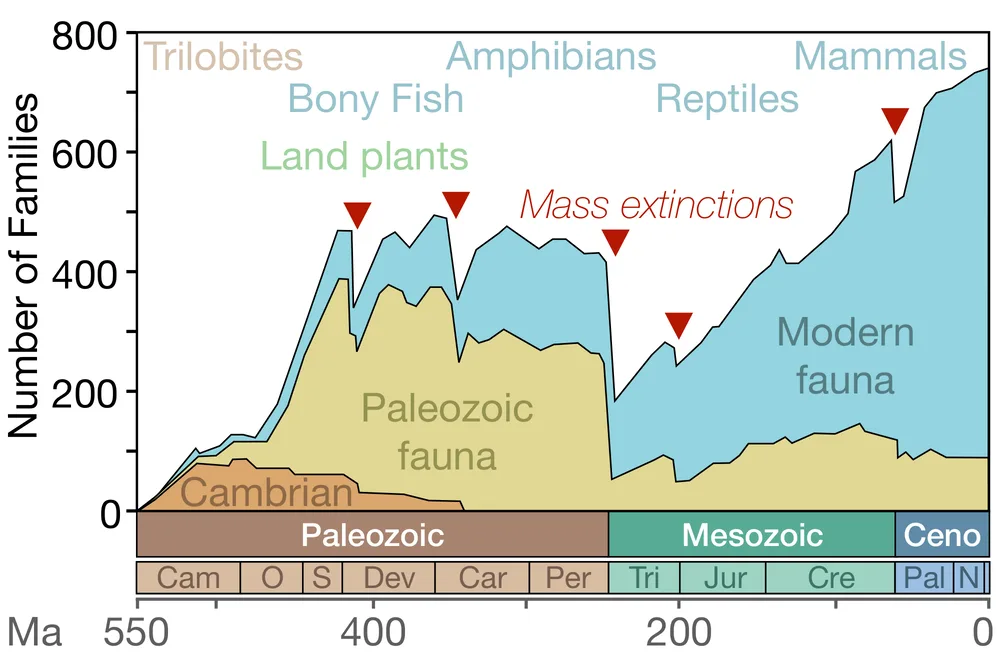
Phanerozoic means "age of visible life", and indeed life became very apparent on earth. The first and longest of three eras in the Phanerozoic eon is the Paleozoic (550-250 Ma), which starts with the Cambrian period (550-500 Ma). The Cambrian explosion was a very quick evolutionary radiation, i.e. a vast increase in biodiversity. All of the major phylogenetic groups that exist today can be found in the fossil record of that time. However, in this first period a distinct Cambrian fauna (animal life) dominated, but then declined and eventually disappeared.
The Cambrian Fauna
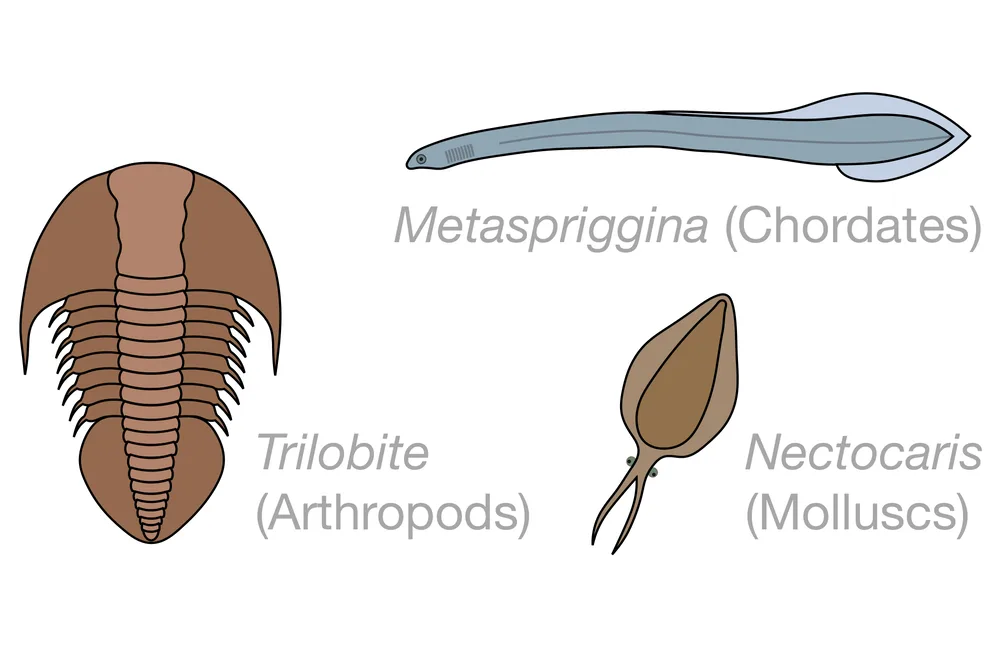
The Cambrian fauna contained "primitive" species of broad phylogenetic groups that are still present today, like arthropods, molluscs or chordates, although now represented by very different species. The long extinct trilobites were very prominent in the early Paleozoic, and are related to today's crustaceans, insects, chelicerates (e.g. spiders) and myriapods. Some of the first chordates like Metaspriggina emerged as well - predecessors of modern chordates/vertebrates, including fishes, amphibians, reptiles, birds and mammals.
Mid Paleozoic
While the seeds for the very broad groups of animals were laid during the Cambrian, later periods of the Paleozoic, which continued with the Ordovician, Silurian, Devonian, Carboniferous and Permian periods, spawned their distinct and very diversified faunas. The first bony fishes emerged in the oceans about 420 Ma (Silurian), separating from cartilaginous fishes, which include sharks and rays. The bony fishes then began to diversify into ray-finned fishes and lobe-finned fishes with fleshy fins.
Conquest of the Land
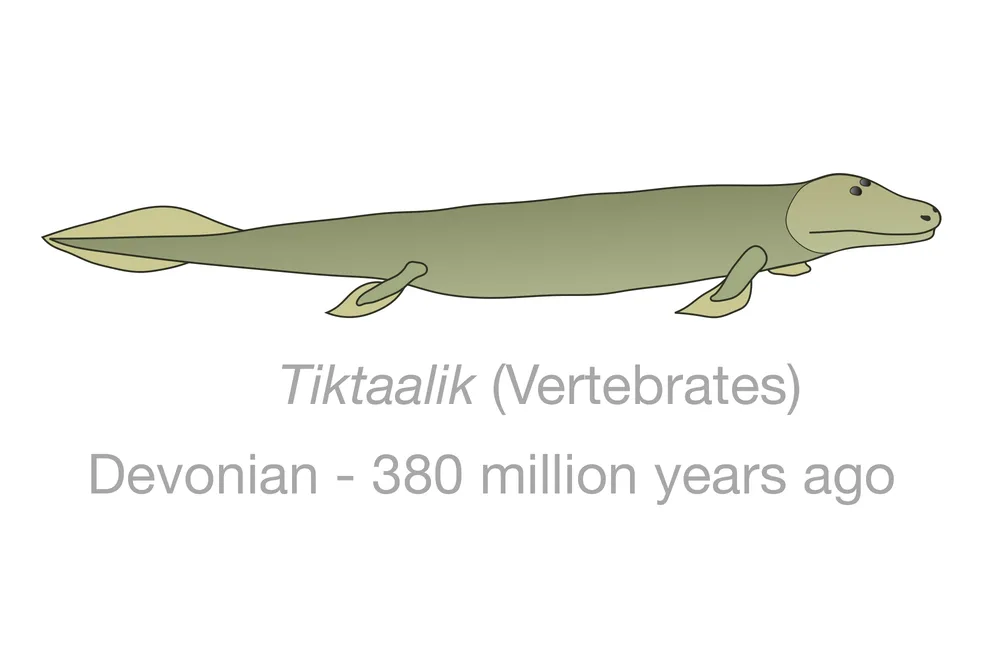
Lobe-finned fishes eventually gave rise to the first land-conquering vertebrates, of which the earliest known representative is Tiktaalik, having lived about 380 Ma (Devonian). This evolutionary link between fishes and tetrapods (four-limbed animals) had both gills and lungs, jointed wrists and a mobile neck. Today's lungfish resemble these ancient species in some ways. Before Tiktaalik however, arthropods already conquered the land 430 Ma (Silurian), while the first land plants emerged 470 Ma (Ordovician).
Late Paleozoic
After conquering the land, the tetrapods began to diversify. The Carboniferous period (360-300 Ma) that followed the Devonian was the "age of amphibians", which were then the dominant land animals. In the next period, the Permian (300-250 Ma) the early groups that will give rise to mammals (synapsids) on the one hand and reptiles and birds (sauropsids) on the other, emerge and separate.
The phanerozoic eon witnessed five mass extinctions, caused by drastic and widespread environmental changes, e.g. drops in atmospheric oxygen, rise in carbon dioxide levels or acidification of the oceans. But the most severe extinction event happened at the transition from the paleozoic to the mesozoic era. It is known as the Great Dying, in which 90% of marine species and 70% of terrestrial vertebrate species, among others, were wiped out. However, life has always recovered and came back more numerous and diverse.
The mesozoic is divided into three periods, the triassic, jurassic and cretaceous. The triassic (250-200 Ma) saw great diversification, among synapsids and sauropsids and many other groups, and ended in another mass extinction. During the triassic, the first mammals, as small rodent-like animals, emerged (225 Ma). The jurassic (200-145 Ma) and cretaceous (145-66 Ma) were dominated by sauropsids/reptiles, particularly by the dinosaurs. The small and inconspicuous mammals existed in their shadows for the whole time.
The Age of Dinosaurs
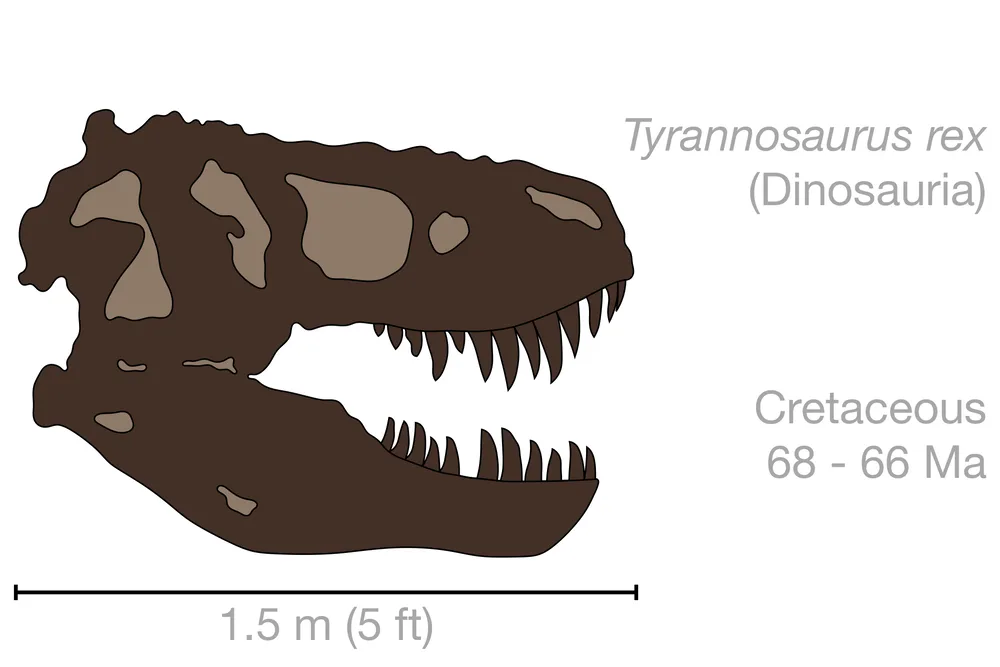
The dinosaurs ruled the world for more than 130 million years and greatly contributed to earth's biodiversity. Names like Stegosaurus, Brachiosaurus, Allosaurus, Velociraptor and Triceratops are well-known around the world and captured the imagination of humanity for many decades and even centuries. The famous Tyrannosaurus rex was among the last dinosaurs, which went extinct due to a massive asteroid impact 66 Ma, together with 75% of the plant and animal species on earth. The reign of the dinosaurs came to a sudden end.
The Cenozoic
The Cenozoic, which is divided into the Paleogene (66-23 Ma), Neogene (23-2.5 Ma) and Quaternary (2.5 Ma - present), became the "age of mammals" after they stepped out of the shadow of the extinct dinosaurs, diversified and became dominant on earth. But the dinosaurs are not really gone. Birds represent a large and successful group of feathered dinosaurs, which originated in the jurassic period. Besides, reptiles and amphibians further contribute to the modern vertebrate fauna on land.
The most recent period, the Quaternary (2.5-0 Ma) saw the evolution of Humans, 4 billion years after life began on earth. Our species, Homo sapiens, evolved around 300,000 years ago. To put that into perspective: If the earth was 24 hours old, humans would have evolved less than 6 seconds ago.
In the next section we will learn how the enormous number of species that are alive today are ordered and classified according to their evolutionary history.