
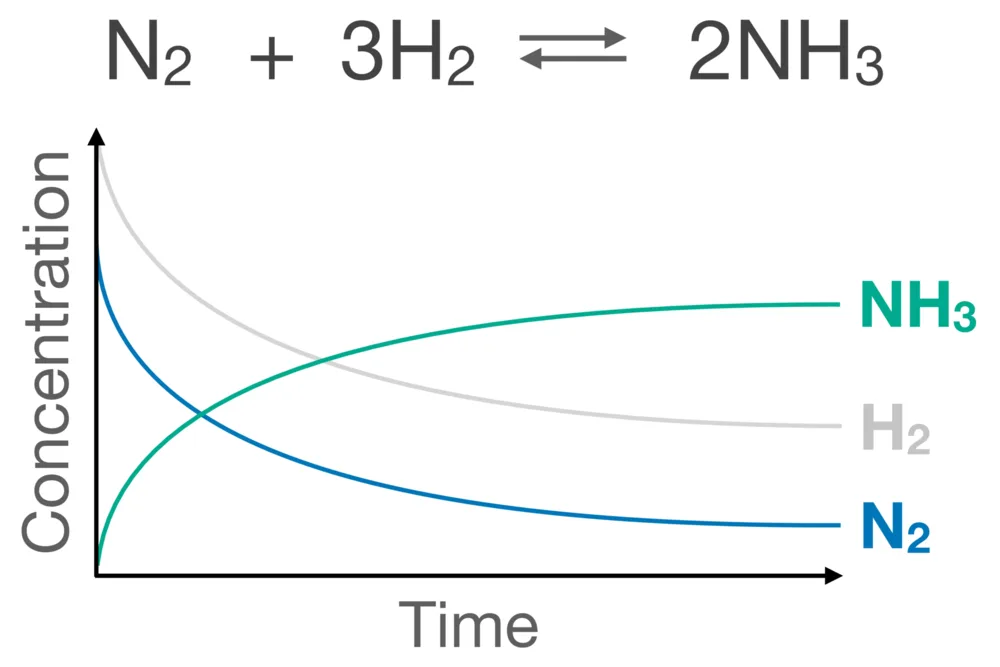
Forward and reverse reactions at equal rates
Amounts of reactants and products stay constant
Most chemical reactions are reversible and can run in both directions. As products accumulate, the reverse reaction speeds up until both directions run at the same rate. The reaction has then reached chemical equilibrium: molecules keep reacting, but the total amounts of reactants and products no longer change. An equilibrium can lie far toward one side, so that either products or reactants dominate. Adding or removing a reactant or product shifts the equilibrium, which is how the bicarbonate buffer absorbs extra protons in the blood. Catalysts and enzymes do not change the position of an equilibrium; they only help a reaction reach it faster.