Type: Pyrimidine
Occurence: RNA
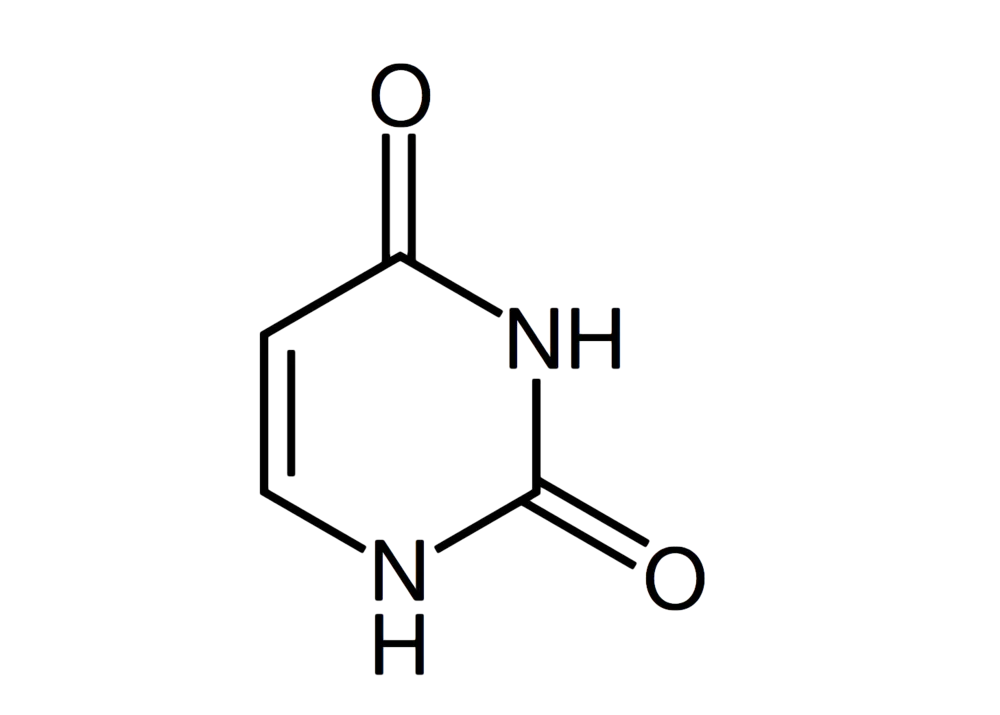
Uracil (U) is one of the four main bases found in RNA, along with adenine, guanine, and cytosine. It is a pyrimidine derivative, with a heterocyclic aromatic ring and two substituents attached (a keto group at position 2 and another keto group at position 6), and is a demethylated form of thymine. The nucleoside of uracil is uridine. In Watson-Crick base pairing, it forms two hydrogen bonds with adenine.
In DNA, uracil is replaced by the nucleobase thymine (5-methyluracil). Uracil can be produced by spontaneous deamination of cytosine through hydrolytic deamination and is excised from double-stranded DNA by Uracil-DNA glycosylase. Its derivatives, such as uridine diphosphate (UDP) or uridine triphosphate (UTP) play specialized roles in metabolism, to a large extent in relation to carbohydrates.
Uracil was isolated by hydrolysis of yeast nuclein in 1900 by Alberto Ascoli. Its name was coined in 1885 by Robert Behrend, who was attempting to synthesize derivatives of uric acid.
Properties
Chemical formula: C₄H₄N₂O₂
Molar mass: 112.09 g/mol
Density: 1.32 g/cm³