Chain: charged (+)
Codons: CGA CGC CGG CGT AGA AGG
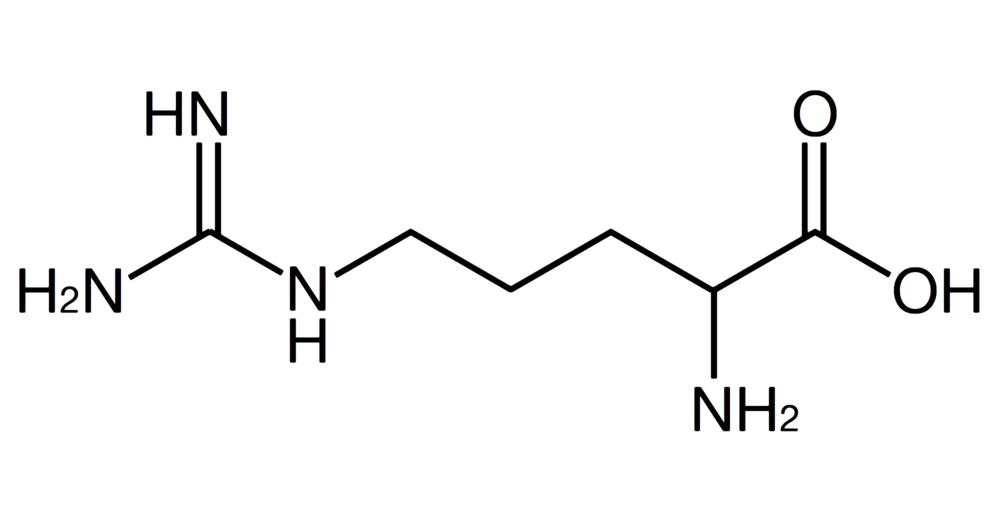
Arginine (codons: CGA, CGC, CGG, CGT, AGA, AGG) is an α-amino acid that is used in the biosynthesis of proteins, specifically its L-isomer (left-handed). It contains an α-amino group, an α-carboxylic acid group, and a side chain consisting of a 3-carbon aliphatic chain ending in a guanidino group. At physiological pH (7.4), the amino group is in the protonated form (−NH₃⁺) and the carboxyl group is in the deprotonated form (−COO−), and the guanidino group is also protonated to give the guanidinium form (-C-(NH₂)₂⁺), making arginine a positively charged amino acid.
Arginine is one of the 20 amino acids encoded in the standard genetic code and is a conditionally essential amino acid in humans, depending on health and age. It is metabollically synthesized in the urea cycle, however in quantities that are not always sufficient. Further, it is the immediate precursor of nitric oxide (NO), an important signaling molecule and regulator of vasodilation. Arginine is typically found on the outside of proteins, where the hydrophilic head group can interact with the polar environment.
In 1886, arginine was first isolated from yellow lupin seedlings by Ernst Schulze and his assistant Ernst Steiger, and named after the Greek word for silver ("argyros") due to the silver-white appearance of arginine nitrate crystals. In 1897, Ernst Schulze and Ernst Winterstein determined the structure of arginine.
Properties
Side chain: hydrophilic (positively charged)
Chemical formula: C₆H₁₄N₄O₂
Molar mass: 174.20 g/mol
Density: 0.70 g/cm³