Chain: polar
Codons: AAC AAT
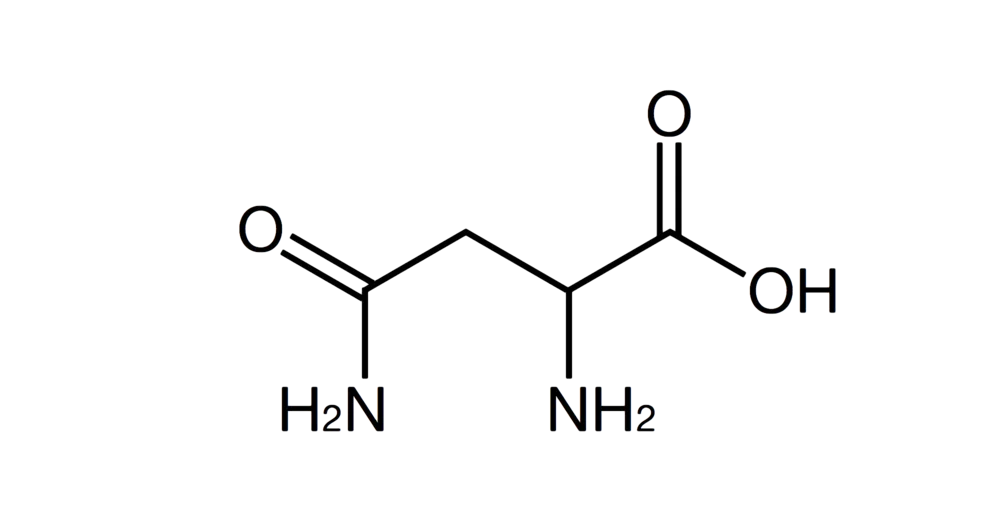
Asparagine (codons: AAC, AAT) is an α-amino acid that is used in the biosynthesis of proteins, specifically its L-isomer (left-handed). It contains an α-amino group, an α-carboxylic acid group, and an aliphatic carboxamide side chain, making it a polar amino acid. At physiological pH (7.4), the amino group is in the protonated form (−NH₃⁺) and the carboxyl group is in the deprotonated form (−COO−).
Asparagine is one of the 20 amino acids encoded in the standard genetic code and is non-essential in humans, as it can be metabollically synthesized. It is generated from oxaloacetate, a metabolic intermediate in many processes, such as the citric acid cycle. First, oxaloacetate is converted to aspartate through transamination, which is then transformed to asparagine though transamidation. Since the asparagine side chain can form hydrogen bond interactions with the peptide backbone, it is often found near the beginning of alpha-helices or in beta sheets.
In 1806, asparagine was first isolated by Louis Nicolas Vauquelin and his assistant Pierre Jean Robiquet from asparagus juice, in reference to which it was named. It was the first amino acid to be isolated. In 1862, Hermann Kolbe largely determined the structure of asparagine and in 1886, Arnaldo Piutti synthesized it for the first time.
Properties
Side chain: hydrophilic (polar, uncharged)
Chemical formula: C₄H₈N₂O₃
Molar mass: 132.12 g/mol
Density: 1.54 g/cm³