Chain: charged (+)
Codons: AAA AAG
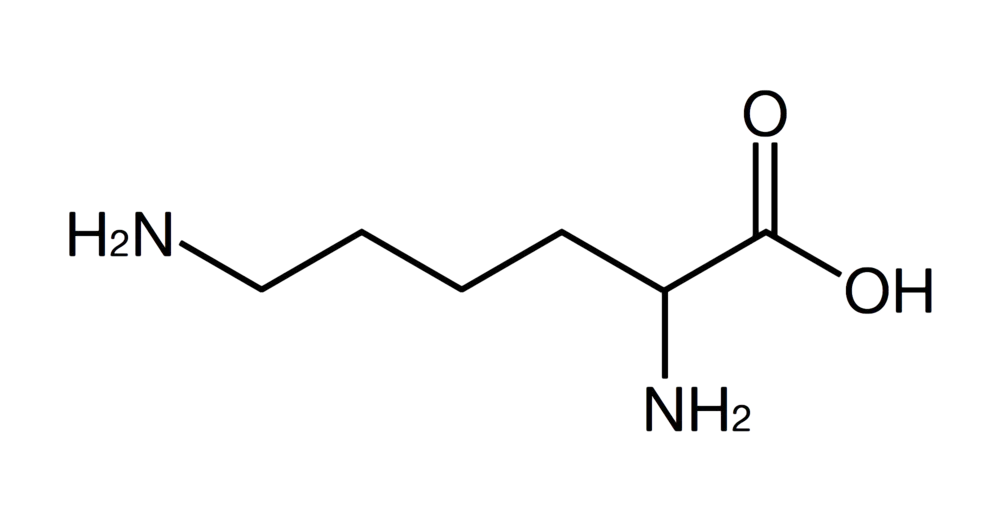
Lysine (codons: AAA, AAG) is an α-amino acid that is used in the biosynthesis of proteins, specifically its L-isomer (left-handed). It contains an α-amino group, an α-carboxylic acid group, and an aliphatic basic lysyl side chain. At physiological pH (7.4), the amino group is in the protonated form (−NH₃⁺) and the carboxyl group is in the deprotonated form (−COO−). Similarly, the lysyl side chain is partially protonated, making it a positively charged amino acid.
Lysine is one of the 20 amino acids encoded in the standard genetic code and is essential in humans, meaning that it cannot be metabollically synthesized, and must be obtained from the diet. In other organisms, such as plants and microorganisms, it is synthesized e. g. from aspartate. It is metabolized into acetyl-CoA, which is an important intermediate in many biochemical reactions. Lysine has various crucial biological functions, including roles in epigenetic regulation as a key part in histone modification and functional changes in proteins through ubiquitination.
In 1889, Edmund Drechsel first isolated lysine from the casein protein of milk. Its chemical formula was determined by his student Max Siegfried in 1891 and its structure was solved in 1902 by Emil Fischer and Fritz Weigert.
Properties
Side chain: hydrophilic (positively charged)
Chemical formula: C₆H₁₄N₂O₂
Molar mass: 146.19 g/mol
Density: 1.10 g/cm³