Chain: nonpolar
Codons: TTC TTT
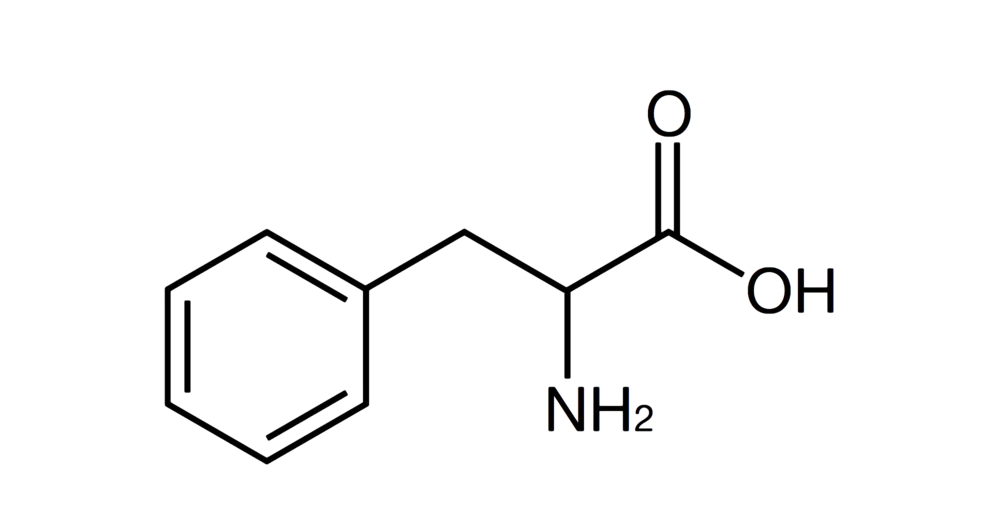
Phenylalanine (codons: TTC, TTT) is an α-amino acid that is used in the biosynthesis of proteins, specifically its L-isomer (left-handed). It contains an α-amino group, an α-carboxylic acid group, and an aromatic benzyl side chain, making it a nonpolar amino acid. At physiological pH (7.4), the amino group is in the protonated form (−NH₃⁺) and the carboxyl group is in the deprotonated form (−COO−). Phenylalanine is structurally similar to alanine with a phenyl group in place of the hydrogen of the methyl group of alanine.
Phenylalanine is one of the 20 amino acids encoded in the standard genetic code and is essential in humans, meaning that it cannot be metabollically synthesized, and must be obtained from the diet. In other organisms, such as plants and microorganisms, it is synthesized through the shikimate pathway. It is a precursor for the amino acid tyrosine, as well as the neurotransmitters dopamine, norepinephrine (noradrenaline), and epinephrine (adrenaline).
In 1879, phenylalanine was first isolated by Ernst Schulze and J. Barbieri from yellow lupine seedlings. Emil Erlenmeyer and A. Lipp were first able to synthesize phenylalanine in 1882. One of its codons, namely TTT (UUU in RNA), was the first one to be decoded through the poly-U experiment conducted by Heinrich Matthaei and Marshall Nirenberg in 1961.
Properties
Side chain: hydrophobic (nonpolar, uncharged)
Chemical formula: C₉H₁₁NO₂
Molar mass: 165.19 g/mol
Density: 1.34 g/cm³