Chain: special case
Codons: CCA CCC CCG CCT
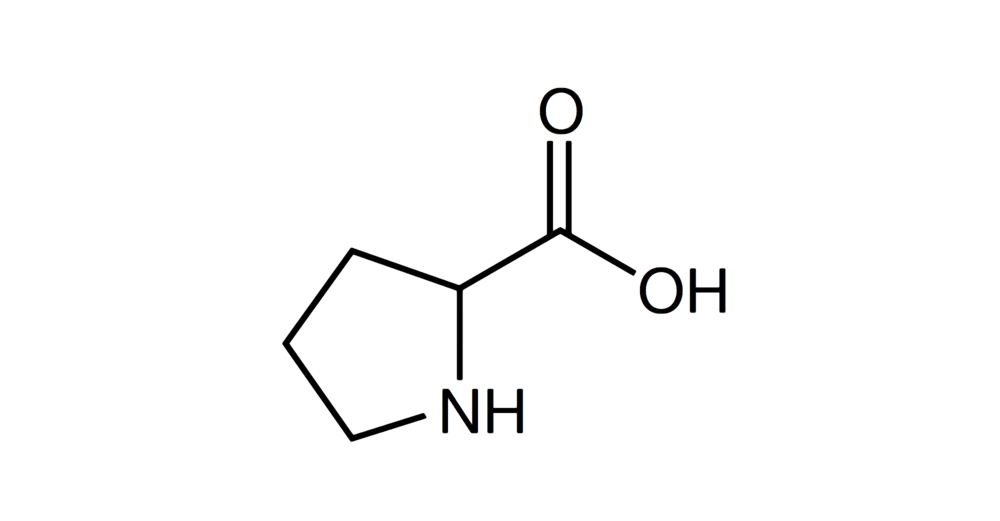
Proline (codons: CCA, CCC, CCG, CCT) is an α-amino acid that is used in the biosynthesis of proteins, specifically its L-isomer (left-handed). It contains an α-amino group, an α-carboxylic acid group, and an aliphatic pyrrolidine side chain. At physiological pH (7.4), the amino group is in the protonated form (−NH₃⁺) and the carboxyl group is in the deprotonated form (−COO−).
Proline is one of the 20 amino acids encoded in the standard genetic code and is non-essential in humans, as it can be metabollically synthesized. It is generated from the non-essential amino acid glutamate. The cyclic structure of the pyrrolidine side chain causes strong conformational rigidity, which affects the secondary structure of proteins near a proline residue. It acts as a structural disruptor of regular secondary structure elements such as alpha helices and beta sheets and is commonly found in turns.
In 1900, proline was isolated for the first time by Richard Willstätter. Shortly after that, Emil Fischer synthesized proline and named it in reference to its pyrrolidine side chain.
Properties
Side chain: special case
Chemical formula: C₅H₉NO₂
Molar mass: 115.13 g/mol
Density: 1.37 g/cm³