Deoxyribonucleic acid

Deoxyribonucleic acid, commonly known as DNA, is used by all life forms as the storage medium for genetic information. DNA contains the fundumental blueprints for development and maintainance for any given organism. While DNA is chemically very similar to RNA, it is different in some key aspects.
This section will provide an overview on its chemical structure, which is inextricably connected to its function.
Deoxyribonucleotides
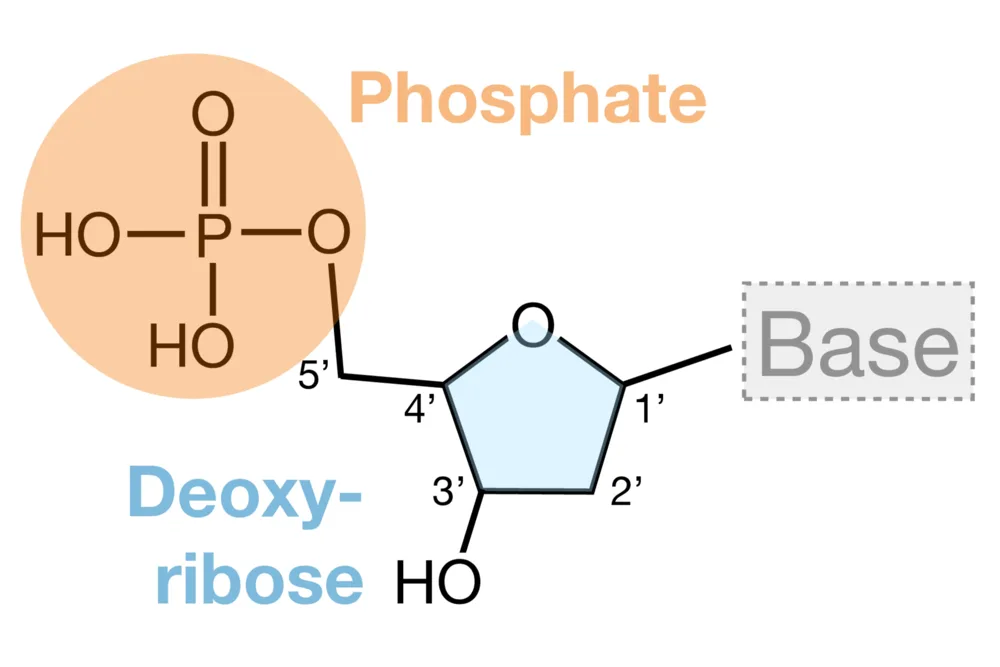
The monomeric units of DNA are deoxyribonucleotides, which are made up of a deoxyribose sugar, a phosphate group and one of four nucleobases. The phosphate group is attached to the 5' carbon atom of the deoxyribose, while the respective base is connected at the 1' carbon. In contrast to RNA, which contains ribose sugar, the deoxyribose of DNA lacks a hydroxyl group (OH) at its 2' carbon. This has important implications for the general structure of DNA, which we will discuss shortly.
Nucleobases
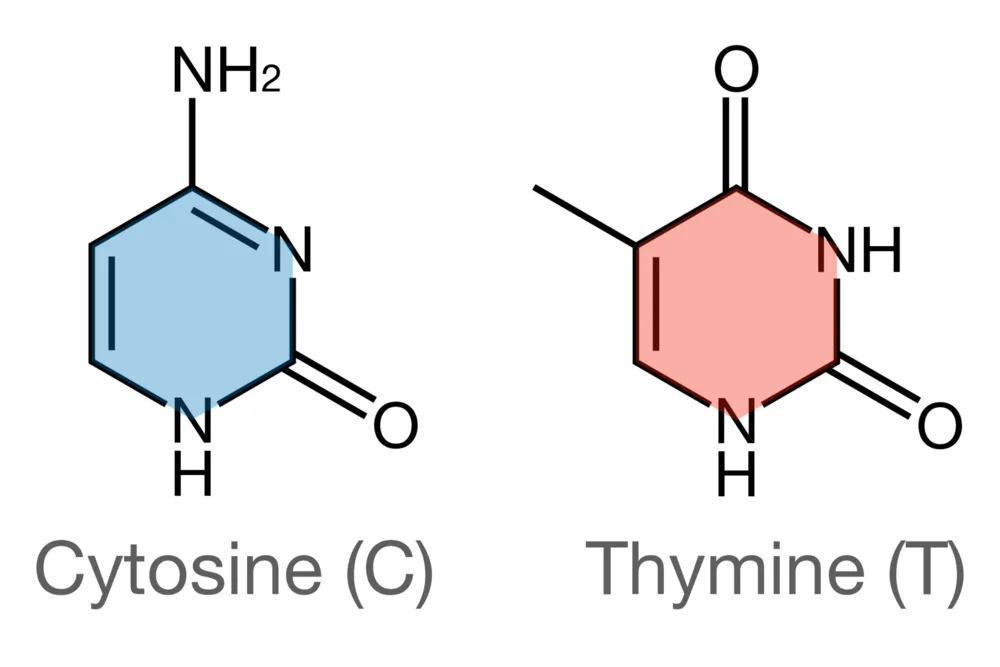
Similar to RNA, fhe four standard bases of DNA can be divided into two types, purines and pyrimidines. Cytosine (C) and thymine (T) are pyrimidines with their typical single ring structure, containing two nitrogen atoms within it. Thymine corresponds to uracil in RNA. In fact, thymine can also be called 5-methyluracil, as it contains a methyl group at the 5' atom of the pyrimidine ring. The connection with deoxyribose is formed at the bottom nitrogen in this depiction.
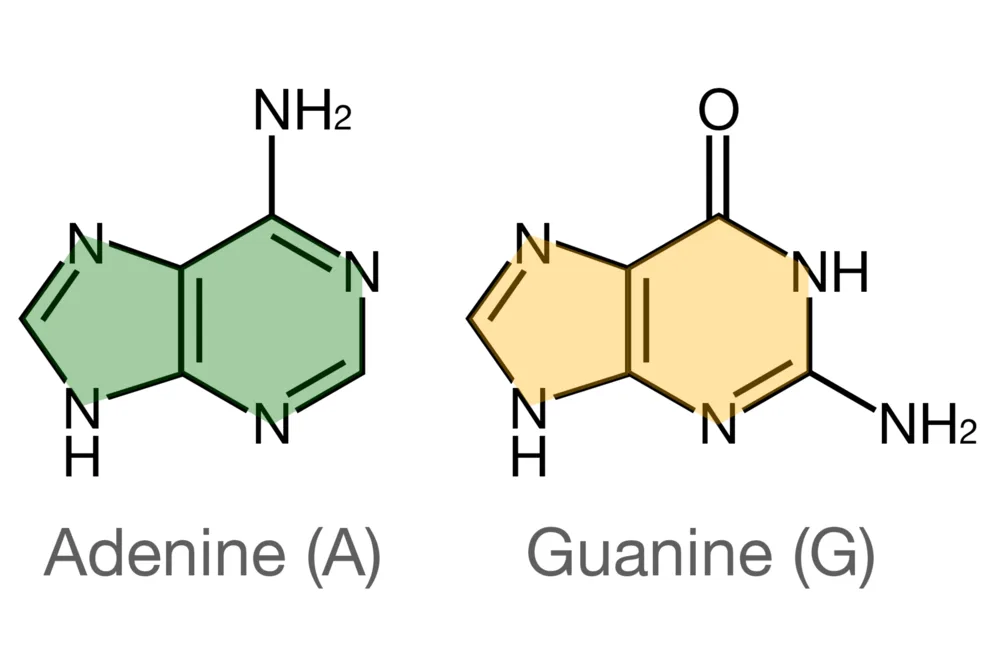
The purine bases adenine (A) and guanine (G) each consist of two nitrogen-containing rings. Together with the pyrimidine cytosine, these bases are identical in both DNA and RNA. In this depiction the bottom left nitrogen of each purine is attached to deoxyribose.
DNA polymerization
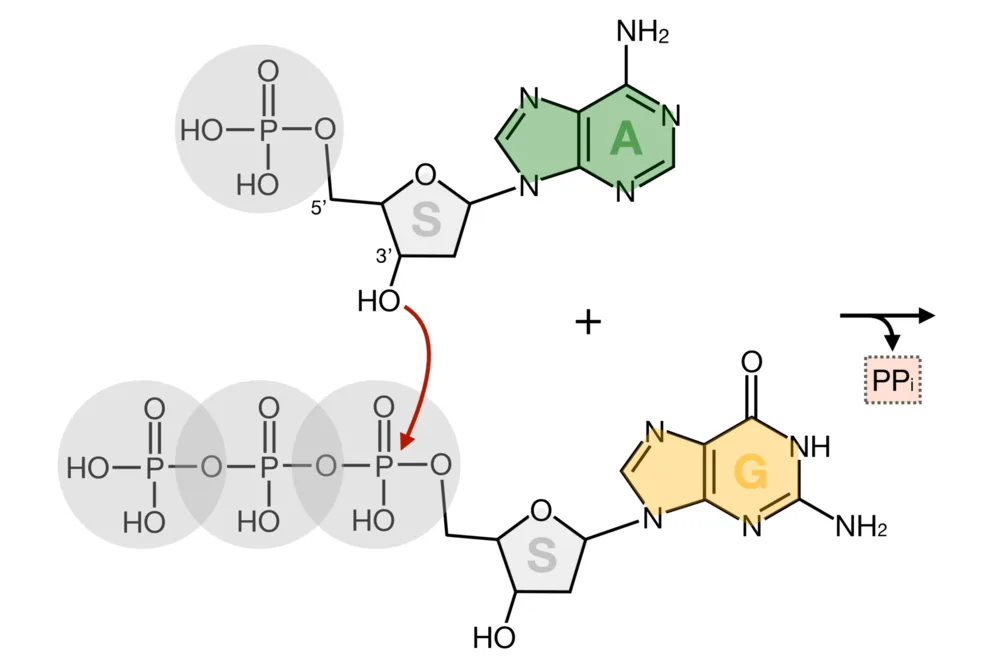
The polymerization of DNA ensues between the 3' hydroxyl group (OH) of the deoxyribose of an existing DNA terminus or single deoxyribonucleotide and the phosphate group that is attached at the 5' carbon of an incoming deoxyribonucleoside triphosphate. During the bond formation, two phosphate groups are released as a diphosphate (PPᵢ), which simultaneously provides energy for the reaction itself.
DNA structure
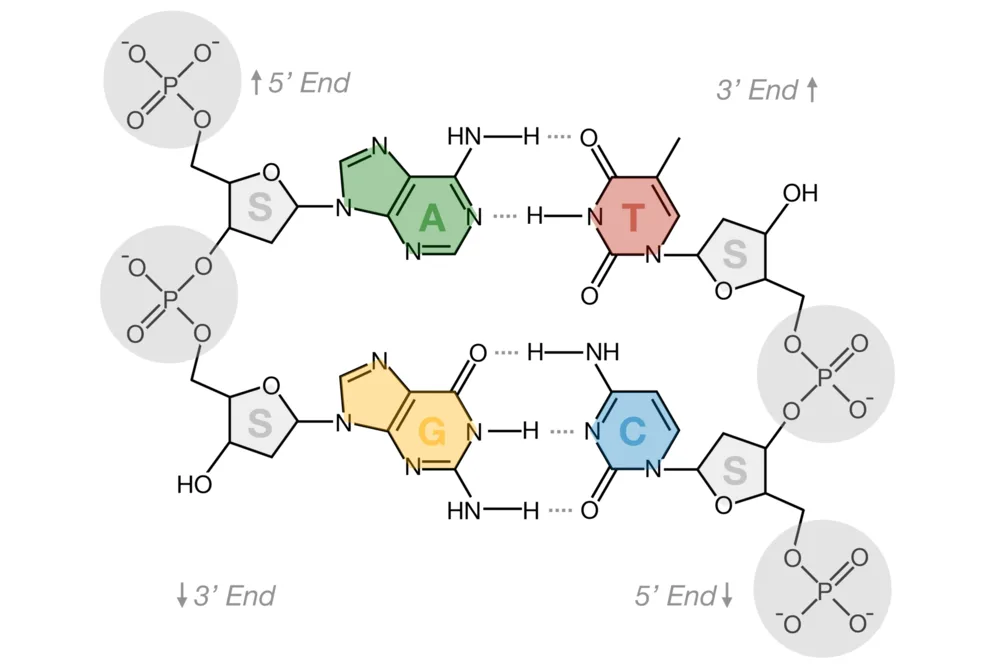
The resulting polymeric DNA is continuously connected by its sugar-phosphate backbone, while the nucleobases reach out at the side of the strand. One terminus of a DNA molecule ends with a phosphate group, which is attached to the 5' carbon of the deoxyribose sugar. Therefore, it is called the 5' end of the DNA strand. The opposite terminus ends with a free 3' OH and is hence called 3' end. Additional nucleotides can only be added to the 3' end of a DNA strand.
DNA is usually double-stranded through its entire length, in contrast to RNA. Two DNA strands associate through specific base pairing, where A only pairs with T and G only pairs with C, being connected through two and three hydrogen bonds, respectively. The two strands run in opposite direction, which is commonly defined as going from 5' end to 3' end. Hence, the two strands of DNA are anti-parallel to each other and reverse complementary in their base sequence, as each base has its distinct pairing match.
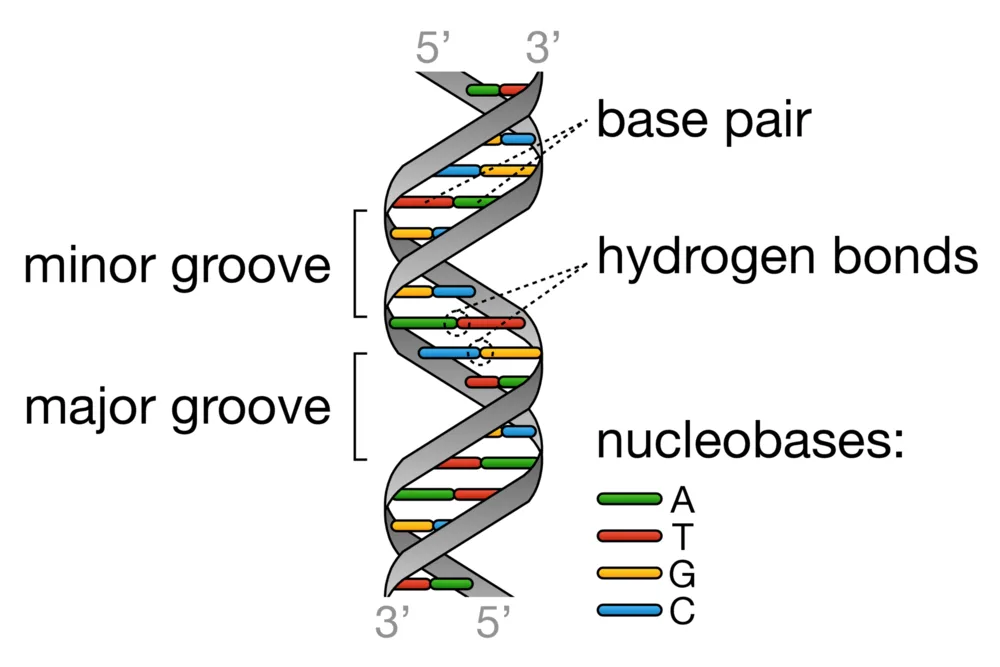
DNA has a helical structure. Specifically, its two strands form a double-helix with the sugar-phosphate backbones (depicted in gray) being located at the outside and the base pairs on the inside that are connected through hydrogen bonds. The DNA double-helix has a major groove, where the sugar-phosphate backbones are further apart and a minor groove, where they are closer together.
The structure of DNA is particularly suitable for its copying and its primary function, namely the storing of genetic information. This information, which is used as the blueprint for the building and maintainance of organisms, lies in the specific base sequence of the DNA with its four "letters" A, G, C, and T.
You will learn more about the copying, reading and translation of the genetic information in the following module on genetics.
DNA modifications
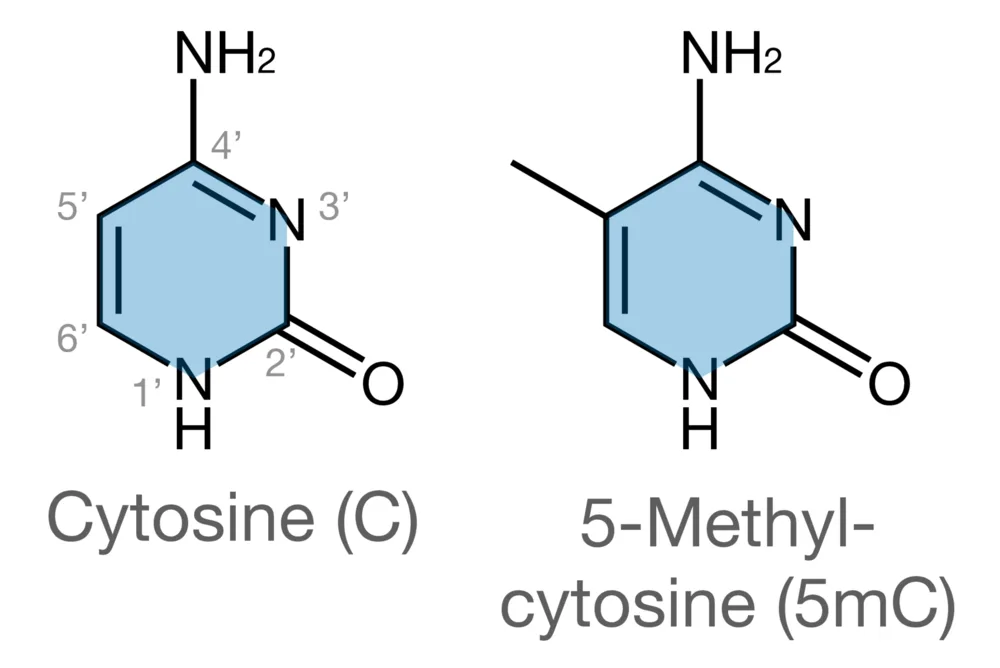
DNA can be modified in various ways, but the most important modification is the DNA methylation. Specifically, this is the methylation of cytosine at the 5' atom of the pyrimidine ring. The resulting base is called 5-methylcytosine and still pairs with guanine, although this small chemical change has profound effects on the regulation of the genetic material. This is an example of an epigenetic modification, which will be discussed later in more detail.