Ribonucleic acid

Ribonucleic acid, or RNA, is a nucleic acid just like DNA, but with consequential differences in its structure and function. While DNA is used for storage of genetic information, RNA is functionally much more versatile. RNA stores and transfers information and is further involved in some fundamental enzymatic functions in complexes with proteins. In fact, RNA might be much older than DNA, which may represent a narrow specialization.
Here, we will learn the most important facts about the chemistry of RNA.
Ribonucleotides
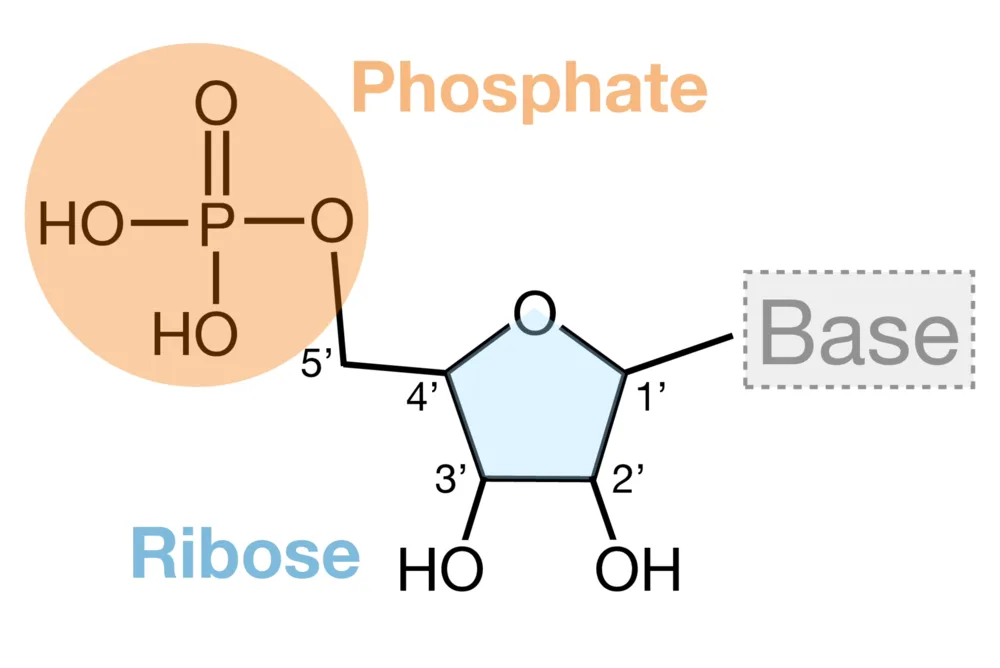
The monomeric units of RNA are ribonucleotides, which are made up of a ribose sugar, a phosphate group and one of four nucleobases. The phosphate group is attached to the 5' carbon atom of the ribose, while the respective base is connected at the 1' carbon. Compounds that only consist of a ribose sugar and a nucleobase are called nucleosides.
Nucleobases
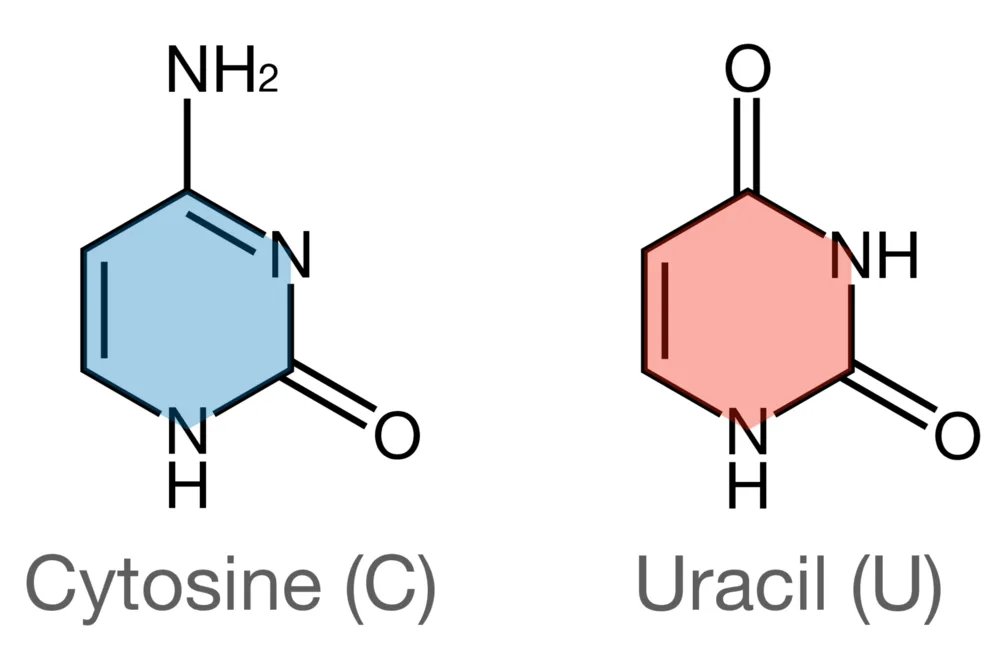
The four standard bases of RNA can be divided into two types, purines and pyrimidines. Cytosine (C) and uracil (U) are pyrimidines with their typical single ring structure, containing two nitrogen atoms within it. The connection with ribose is formed at the bottom nitrogen in this depiction.
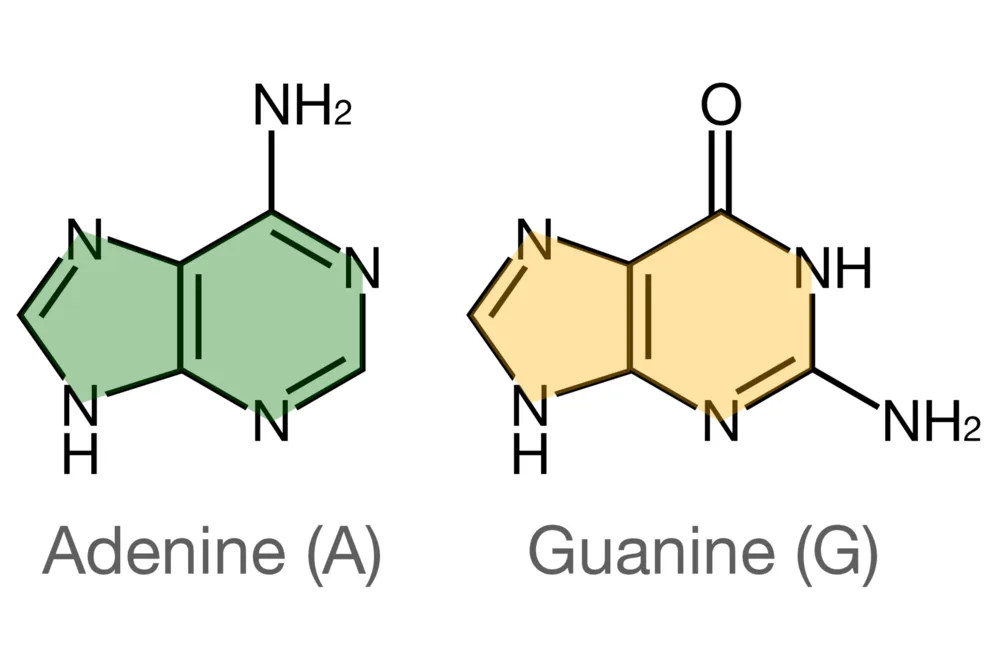
The purine bases adenine (A) and guanine (G) each consist of two nitrogen-containing rings. In this depiction the bottom left nitrogen of each purine is attached to ribose.
Nucleoside triphosphates
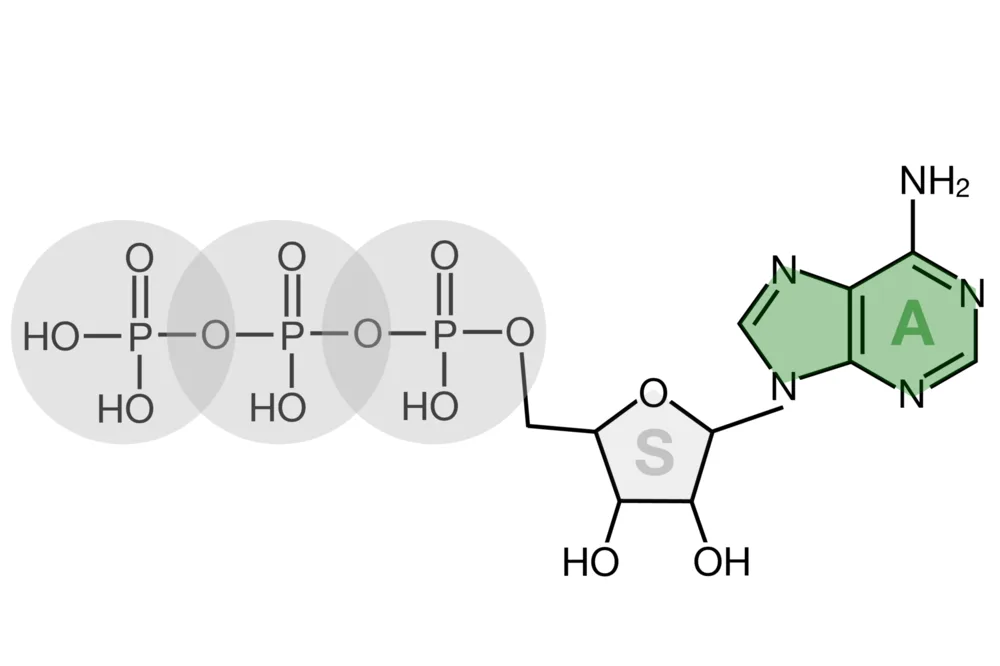
While nucleotides are the monomeric units of RNA, their polymerization occurs through respective precursors, namely nucleoside triphosphates. These molecules, especially adenosine triphosphate (ATP), also have highly important roles in energy transfer and cell signalling.
RNA polymerization
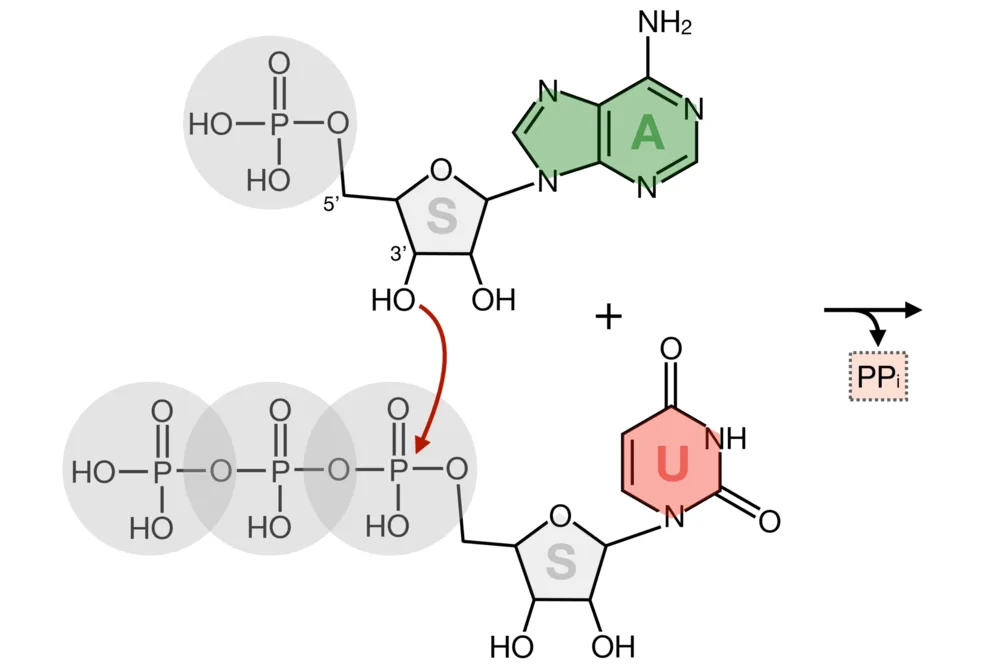
The polymerization of RNA, namely the connection of ribonucleotides, ensues between the 3' hydroxyl group (OH) of the ribose of an existing RNA terminus or single ribonucleotide and the phosphate group that is attached at the 5' carbon of an incoming nucleoside triphosphate. During the bond formation, two phosphate groups are released as a diphosphate (PPᵢ), which simultaneously provides energy for the reaction itself.
RNA structure
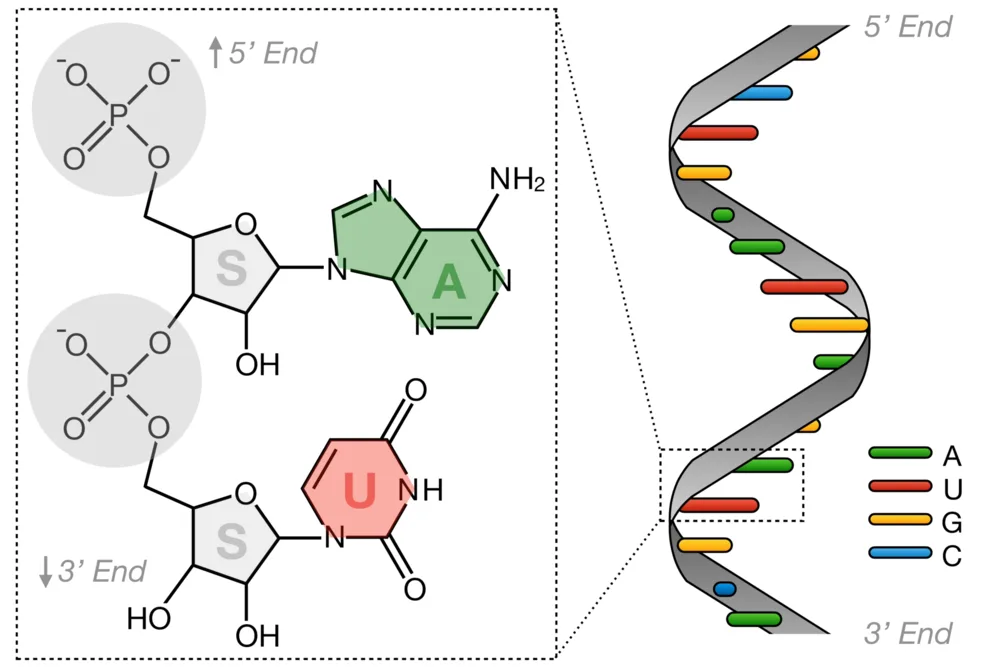
The resulting RNA strand is continuously connected by its sugar-phosphate backbone, while the nucleobases reach out at the side of the strand, which has an overall helical structure. One terminus of the RNA ends with a phosphate group, which is attached to the 5' carbon of the ribose sugar. Therefore, it is called the 5' end of the RNA. The opposite terminus ends with a free 3' OH and is hence called 3' end. Additional nucleotides can only be added to the 3' end of an RNA.
RNA base pairing
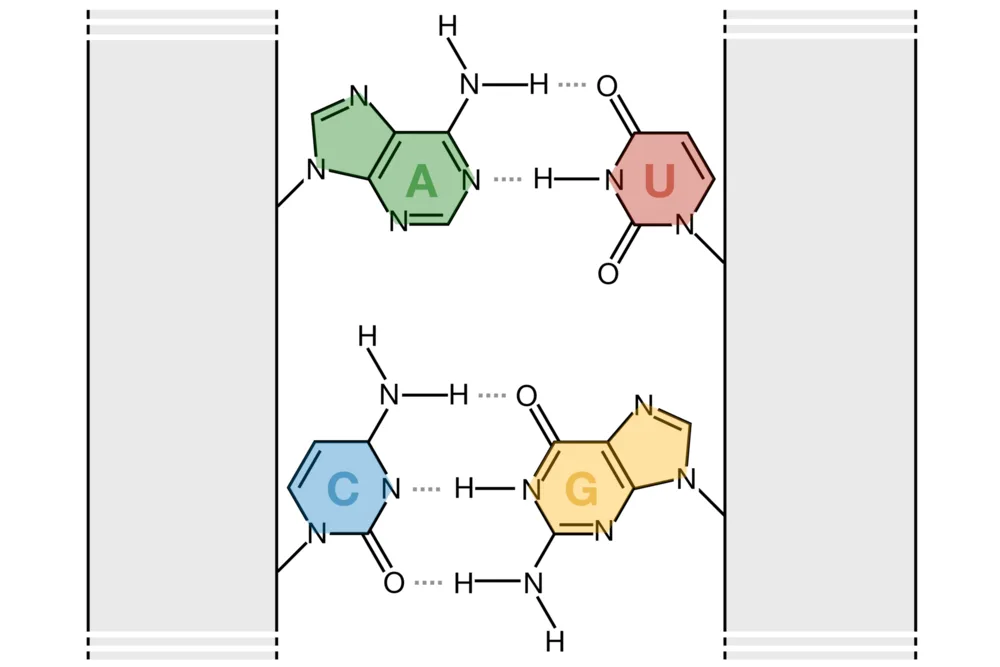
RNA is generally single-stranded, in contrast to DNA, meaning that two RNA strands normally do not pair along their complete length. However, RNA strands commonly fold back through pairing of specific bases which form hydrogen bonds. Only two different base pairings can occur, namely A-U and G-C. A and U form two hydrogen bonds, while G and C form three hydrogen bonds, making the latter pairing slightly more stable.
RNA folding
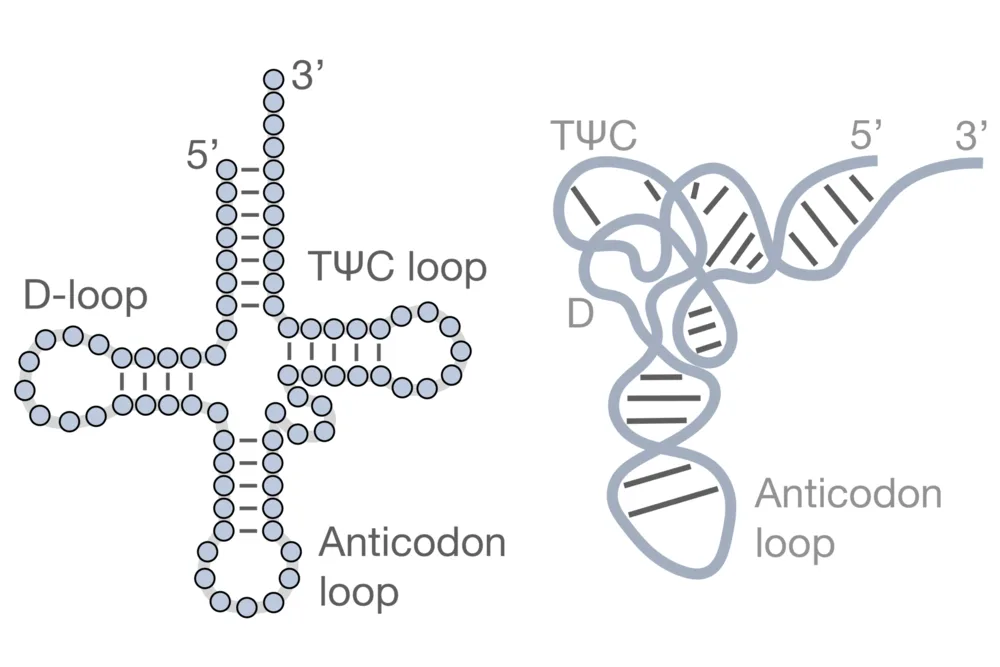
In this way, RNA molecules can form well-defined secondary structures that are crucial for their function. An important example are transfer RNAs (tRNAs). The two-dimensional folding structure of tRNAs is the typical clover leaf form with three specific loops and a forth variable loop of unpaired bases, while the stems or arms are base paired and locally double-stranded regions. The actual three-dimensional structure, depicted on the right, is more complicated, as there is additional folding of the different arms.