
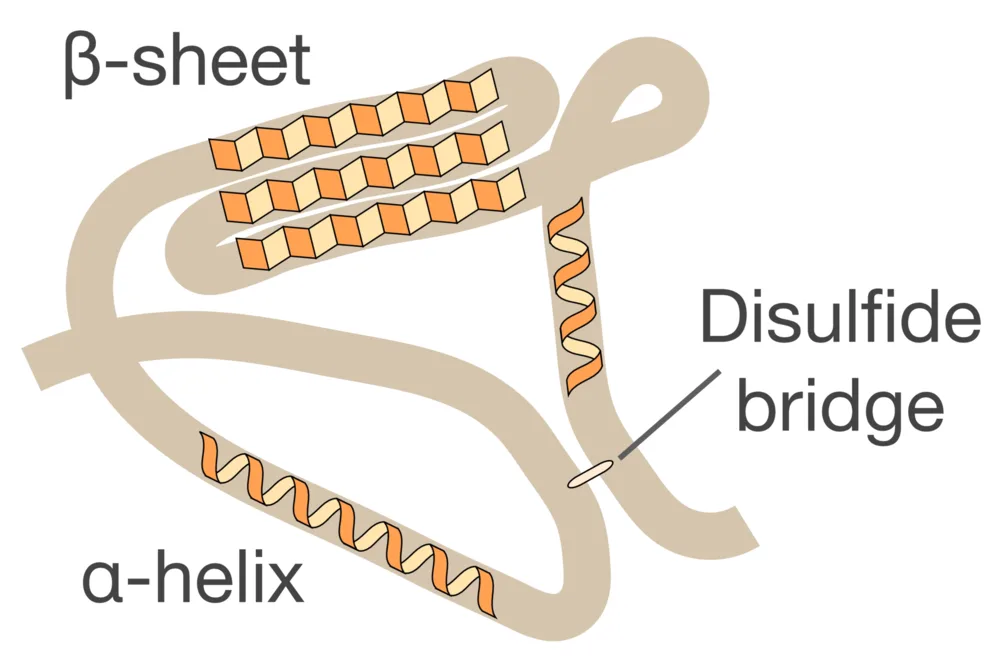
Covalent S–S bridge between two cysteines
Stabilizes the folding of proteins
A disulfide bond is a covalent bond between two sulfur atoms. In proteins, it forms when the thiol groups (–SH) of two cysteine side chains are oxidized and join into an S–S bridge. Because the two cysteines can lie far apart in the amino acid sequence, a disulfide bond can lock distant parts of a chain together and so stabilize the tertiary structure. It can also connect separate chains, as in insulin and antibodies. Disulfide bonds are especially common in proteins that act outside the cell, and they are the reason a perm can reshape the keratin of hair.