Complete vs. partial dissociation in water
Decides how many protons an acid releases
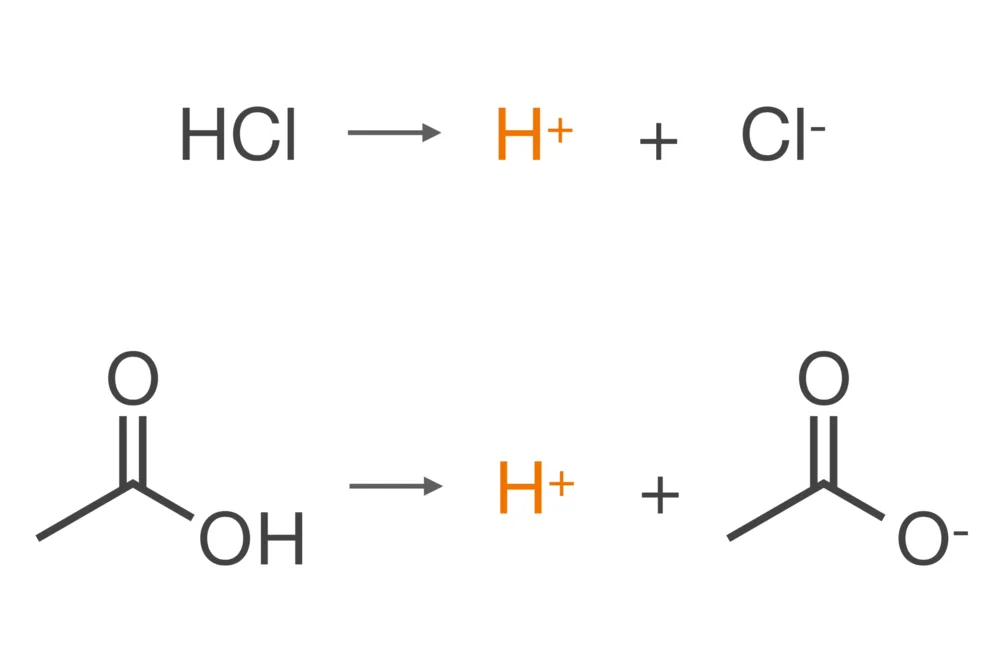
A strong acid dissociates completely in water: every molecule of hydrochloric acid (HCl) releases its proton, giving H⁺ and Cl⁻ ions. A weak acid dissociates only partially, so a considerable share of its molecules stays intact. Acetic acid (CH₃COOH) and carbonic acid (H₂CO₃) are examples. Bases are classified the same way: sodium hydroxide (NaOH) is a strong base, while ammonia (NH₃) is a weak base, because only some of its molecules accept a proton. Most acids and bases in cells are weak, which is why a weak acid and its conjugate base can work together as a buffer.